000-001-C13
OspA Control Protein

Cannot supply to this region.
- SKU:
- 000-001-C13
- Additional Names:
- ospA, BB_A15|Outer surface protein A, Borrelia burgdorferi OspA, control protein
- Application:
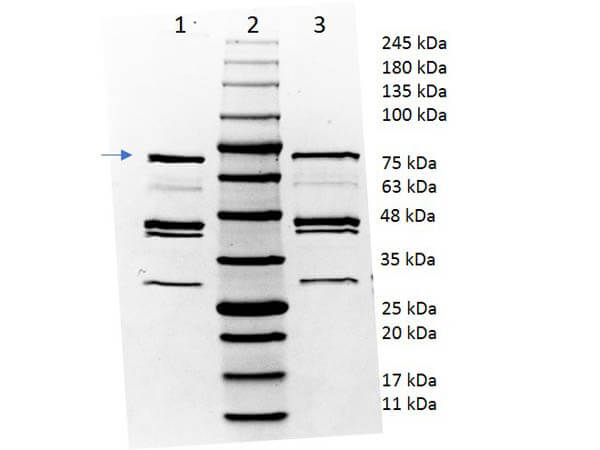
- ELISA, SDS-PAGE, WB, FuncS, Functional Assay
- Concentration:
- 1 mg/ml
- Physical State:
- Liquid
- Purity:
- >90%
- Storage Conditions:
- Please refer to datasheet
- Supplier:
- Rockland Inc
- Buffer:
- 0.02 M Potassium Phosphate, 0.15 M Sodium Chloride
- Immunogen:
- ospA, BB_A15
- Formulation:
- 0.02 M Potassium Phosphate, 0.15 M Sodium Chloride, pH 7.2
- Species:
- Bacteria
- Uniprot:
- P0CL66
- Synonyms:
- BB_A15;BB_RS05180;outer surface lipoprotein OspA
- Extra Details:
- Outer-Surface Protein A (OspA), a lipoprotein from Borrelia burgdorferi encoded on its Plasmid lp54, is a major component of the spirochete's extracellular matrix. OspA probably serves as a lipid-anchor. The spirochetes migrate from the tick midgut during feeding to its salivary glands and are thus transmitted to the mammal host. This transition may be facilitated by changes in expression of some B. burgdorferi genes. Upon transmission of the spirochete from the Ixodes tick to mammalian host, the transcript level of OspA can change. It is believed that expression of the various proteins associated with the spirochete may be regulated by the changes in tick life cycle, changes in conditions during tick feeding (such as temperature, pH, and nutrients) and/or in coordination with the course of infection of the mammal host. B. burgdorferi can attach to (and also differentially express antigens in) diverse tissues within the vertebrate host and the tick vector, suggesting that physiological factors other than pH and temperature may play roles in modulating B. burgdorferi gene expression. Lyme disease proteins are ideal for researchers interested in immunology, neurology, rheumatology, coinfections, autoimmune, and neurodegenerative diseases.
- Shipping Conditions:
- Dry Ice