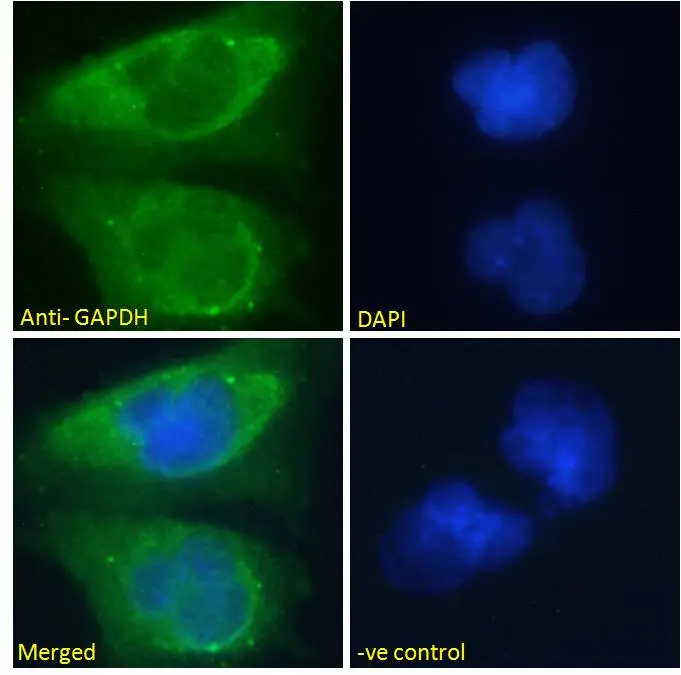
GTX89409
GAPDH antibody, Internal

Cannot supply to this region.
- SKU:
- GTX89409
- Additional Names:
- glyceraldehyde-3-phosphate dehydrogenase , G3PD , GAPD , HEL-S-162eP
- Application:
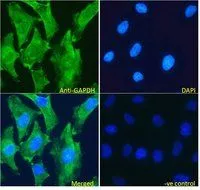
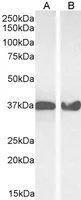
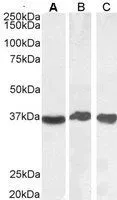
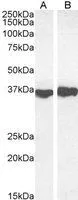
- WB, IHC-P, IF, ICC
- Concentration:
- 0.50 mg/ml
- Physical State:
- Liquid
- Species Reactivity:
- Human
- Purification:
- Ammonium Sulfate Precipitated; Affinity Purified
- Storage Conditions:
- -20[o]C Aliquot. Avoid freeze/thaw cycles. Store undiluted., 2-8[o]C Aliquot. Avoid freeze/thaw cycles. Store undiluted., -20[o]C/-70[o]C Aliquot. Avoid freeze/thaw cycles. Store undiluted.
- Supplier:
- Genetex
- Host:
- Goat
- Reactivities:
- Human, Mouse, Rat
- Buffer:
- TBS, 0.5% BSA, 0.02% Sodium azide.
- Immunogen:
- Peptide with sequence C-GVNHEKYDNSLK, from the internal region of the protein sequence according to NP_002037.2; NP_001243728.1.
- Uniprot:
- P04406
- Synonyms:
- aging-associated gene 9 protein;epididymis secretory sperm binding protein Li 162eP;G3PD;GAPD;glyceraldehyde-3-phosphate dehydrogenase;HEL-S-162eP;OCAS, p38 component;Oct1 coactivator in S phase, 38 Kd component;peptidyl-cysteine S-nitrosylase GAPDH
- Extra Details:
- This gene encodes a member of the glyceraldehyde-3-phosphate dehydrogenase protein family. The encoded protein has been identified as a moonlighting protein based on its ability to perform mechanistically distinct functions. The product of this gene catalyzes an important energy-yielding step in carbohydrate metabolism, the reversible oxidative phosphorylation of glyceraldehyde-3-phosphate in the presence of inorganic phosphate and nicotinamide adenine dinucleotide (NAD). The encoded protein has additionally been identified to have uracil DNA glycosylase activity in the nucleus. Also, this protein contains a peptide that has antimicrobial activity against E. coli, P. aeruginosa, and C. albicans. Studies of a similar protein in mouse have assigned a variety of additional functions including nitrosylation of nuclear proteins, the regulation of mRNA stability, and acting as a transferrin receptor on the cell surface of macrophage. Many pseudogenes similar to this locus are present in the human genome. Alternative splicing results in multiple transcript variants. [provided by RefSeq, Nov 2014]
- Shipping Conditions:
- Blue Ice