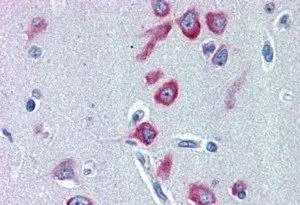
GTX89406
PCK1 antibody, Internal

Cannot supply to this region.
- SKU:
- GTX89406
- Additional Names:
- phosphoenolpyruvate carboxykinase 1 , PCKDC , PEPCK-C , PEPCK1 , PEPCKC
- Application:
- IHC-P
- Concentration:
- 0.50 mg/ml
- Physical State:
- Liquid
- Species Reactivity:
- Human
- Purification:
- Ammonium Sulfate Precipitated; Affinity Purified
- Storage Conditions:
- -20[o]C Aliquot. Avoid freeze/thaw cycles. Store undiluted., 2-8[o]C Aliquot. Avoid freeze/thaw cycles. Store undiluted., -20[o]C/-70[o]C Aliquot. Avoid freeze/thaw cycles. Store undiluted.
- Supplier:
- Genetex
- Host:
- Goat
- Reactivities:
- Human
- Buffer:
- TBS, 0.5% BSA, 0.02% Sodium azide.
- Immunogen:
- Peptide with sequence C-HVNWFRKDKEGK, from the internal region of the protein sequence according to NP_002582.3.
- Uniprot:
- P35558
- Synonyms:
- PCKDC;PEP carboxykinase;PEPCK-C;PEPCK1;PEPCKC;phosphoenolpyruvate carboxykinase 1 (soluble);phosphoenolpyruvate carboxykinase, cytosolic;phosphoenolpyruvate carboxykinase, cytosolic [GTP];phosphoenolpyruvate carboxylase;phosphopyruvate carboxylase;serine-protein kinase PCK1
- Extra Details:
- This gene is a main control point for the regulation of gluconeogenesis. The cytosolic enzyme encoded by this gene, along with GTP, catalyzes the formation of phosphoenolpyruvate from oxaloacetate, with the release of carbon dioxide and GDP. The expression of this gene can be regulated by insulin, glucocorticoids, glucagon, cAMP, and diet. Defects in this gene are a cause of cytosolic phosphoenolpyruvate carboxykinase deficiency. A mitochondrial isozyme of the encoded protein also has been characterized. [provided by RefSeq, Jul 2008]
- Shipping Conditions:
- Blue Ice