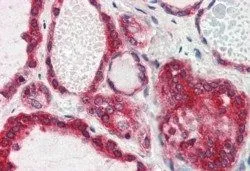
GTX89240
Lipin 3 antibody, Internal

Cannot supply to this region.
- SKU:
- GTX89240
- Additional Names:
- lipin 3 , LIPN3L , SMP2
- Application:
- IHC-P
- Concentration:
- 0.50 mg/ml
- Physical State:
- Liquid
- Species Reactivity:
- Human
- Purification:
- Ammonium Sulfate Precipitated; Affinity Purified
- Storage Conditions:
- -20[o]C Aliquot. Avoid freeze/thaw cycles. Store undiluted., 2-8[o]C Aliquot. Avoid freeze/thaw cycles. Store undiluted., -20[o]C/-70[o]C Aliquot. Avoid freeze/thaw cycles. Store undiluted.
- Supplier:
- Genetex
- Host:
- Goat
- Reactivities:
- Human
- Buffer:
- TBS, 0.5% BSA, 0.02% Sodium azide.
- Immunogen:
- Peptide with sequence C-KPKQKEDAVATD, from the internal region of the protein sequence according to NP_075047.1.
- Uniprot:
- Q9BQK8
- Synonyms:
- dJ620E11.2;Lipin-3;Lipin-3-like;LIPN3L;phosphatidate phosphatase LPIN3;SMP2
- Extra Details:
- The protein encoded by this gene is a member of the lipin family of proteins, and all family members share strong homology in their C-terminal region. This protein is thought to form hetero-oligomers with other lipin family members, while one family member, lipin 1, can also form homo-oligomers. This protein contains conserved motifs for phosphatidate phosphatase 1 (PAP1) activity as well as a domain that interacts with a transcriptional co-activator. Lipin complexes act in the cytoplasm to catalyze the dephosphorylation of phosphatidic acid to produce diacylglycerol, which is the precursor of both triglycerides and phospholipids. Lipin complexes are also thought to regulate gene expression as transcriptional co-activators in the nucleus. Alternative splicing results in multiple transcript variants. [provided by RefSeq, Sep 2014]
- Shipping Conditions:
- Blue Ice