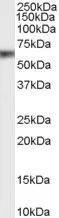
GTX89205
EphB2 antibody, Internal

Cannot supply to this region.
- SKU:
- GTX89205
- Additional Names:
- EPH receptor B2 , CAPB , DRT , EK5 , EPHT3 , ERK , Hek5 , PCBC , Tyro5
- Application:
- WB
- Concentration:
- 0.50 mg/ml
- Physical State:
- Liquid
- Species Reactivity:
- Human
- Purification:
- Ammonium Sulfate Precipitated; Affinity Purified
- Storage Conditions:
- -20[o]C Aliquot. Avoid freeze/thaw cycles. Store undiluted., 2-8[o]C Aliquot. Avoid freeze/thaw cycles. Store undiluted., -20[o]C/-70[o]C Aliquot. Avoid freeze/thaw cycles. Store undiluted.
- Supplier:
- Genetex
- Host:
- Goat
- Reactivities:
- Human
- Buffer:
- TBS, 0.5% BSA, 0.02% Sodium azide.
- Immunogen:
- Peptide with sequence C-QKDRNHRPKFGQ, from the internal region of the protein sequence according to NP_004433.2; NP_059145.2.
- Uniprot:
- P29323
- Synonyms:
- BDPLT22;CAPB;developmentally-regulated Eph-related tyrosine kinase;DRT;EK5;elk-related tyrosine kinase;eph tyrosine kinase 3;EPH-like kinase 5;ephrin type-B receptor 2;EPHT3;ERK;Hek5;PCBC;protein-tyrosine kinase HEK5;renal carcinoma antigen NY-REN-47;Tyro5;tyrosine-protein kinase receptor EPH-3;tyrosine-protein kinase TYRO5
- Extra Details:
- This gene encodes a member of the Eph receptor family of receptor tyrosine kinase transmembrane glycoproteins. These receptors are composed of an N-terminal glycosylated ligand-binding domain, a transmembrane region and an intracellular kinase domain. They bind ligands called ephrins and are involved in diverse cellular processes including motility, division, and differentiation. A distinguishing characteristic of Eph-ephrin signaling is that both receptors and ligands are competent to transduce a signaling cascade, resulting in bidirectional signaling. This protein belongs to a subgroup of the Eph receptors called EphB. Proteins of this subgroup are distinguished from other members of the family by sequence homology and preferential binding affinity for membrane-bound ephrin-B ligands. Allelic variants are associated with prostate and brain cancer susceptibility. Alternative splicing results in multiple transcript variants. [provided by RefSeq, May 2015]
- Shipping Conditions:
- Blue Ice