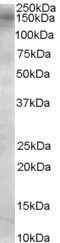
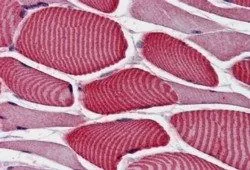
GTX89152
AS160 / TBC1D4 antibody, Internal

Cannot supply to this region.
- SKU:
- GTX89152
- Additional Names:
- TBC1 domain family member 4 , AS160 , NIDDM5
- Application:
- WB, IHC-P
- Concentration:
- 0.50 mg/ml
- Physical State:
- Liquid
- Species Reactivity:
- Human
- Purification:
- Ammonium Sulfate Precipitated; Affinity Purified
- Storage Conditions:
- -20[o]C Aliquot. Avoid freeze/thaw cycles. Store undiluted., 2-8[o]C Aliquot. Avoid freeze/thaw cycles. Store undiluted., -20[o]C/-70[o]C Aliquot. Avoid freeze/thaw cycles. Store undiluted.
- Supplier:
- Genetex
- Host:
- Goat
- Reactivities:
- Human
- Buffer:
- TBS, 0.5% BSA, 0.02% Sodium azide.
- Immunogen:
- Peptide with sequence C-DDPEKIEERKKSK, from the internal region of the protein sequence according to NP_055647.2.
- Uniprot:
- O60343
- Synonyms:
- akt substrate of 160 kDa;AS160;NIDDM5;TBC (Tre-2, BUB2, CDC16) domain-containing protein;TBC1 domain family member 4
- Extra Details:
- This gene is a member of the Tre-2/BUB2/CDC16 domain family. The protein encoded by this gene is a Rab-GTPase-activating protein, and contains two phopshotyrosine-binding domains (PTB1 and PTB2), a calmodulin-binding domain (CBD), a Rab-GTPase domain, and multiple AKT phosphomotifs. This protein is thought to play an important role in glucose homeostasis by regulating the insulin-dependent trafficking of the glucose transporter 4 (GLUT4), important for removing glucose from the bloodstream into skeletal muscle and fat tissues. Reduced expression of this gene results in an increase in GLUT4 levels at the plasma membrane, suggesting that this protein is important in intracellular retention of GLUT4 under basal conditions. When exposed to insulin, this protein is phosphorylated, dissociates from GLUT4 vesicles, resulting in increased GLUT4 at the cell surface, and enhanced glucose transport. Phosphorylation of this protein by AKT is required for proper translocation of GLUT4 to the cell surface. Individuals homozygous for a mutation in this gene are at higher risk for type 2 diabetes and have higher levels of circulating glucose and insulin levels after glucose ingestion. Alternative splicing results in multiple transcript variants encoding different isoforms. [provided by RefSeq, Aug 2015]
- Shipping Conditions:
- Blue Ice