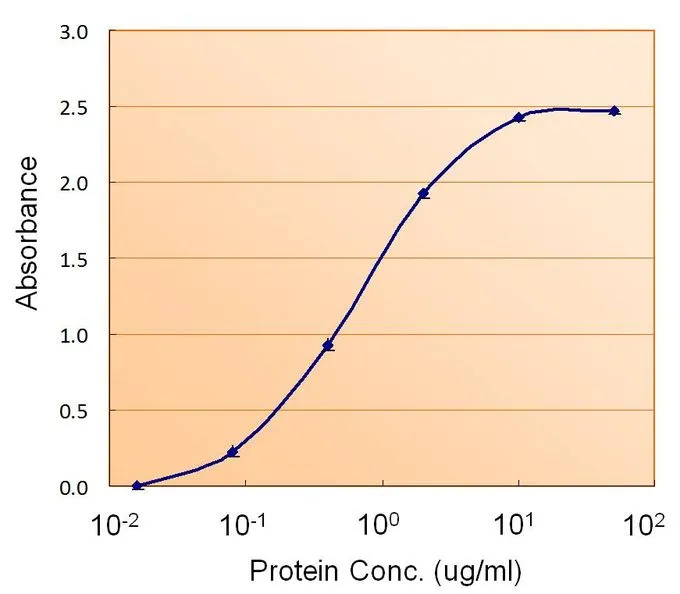
GTX89089
ACACB antibody, Internal

Cannot supply to this region.
- SKU:
- GTX89089
- Additional Names:
- acetyl-CoA carboxylase beta , ACC2 , ACCB , HACC275
- Application:
- ELISA, WB
- Concentration:
- 0.50 mg/ml
- Physical State:
- Liquid
- Species Reactivity:
- Human
- Purification:
- Ammonium Sulfate Precipitated; Affinity Purified
- Storage Conditions:
- -20[o]C Aliquot. Avoid freeze/thaw cycles. Store undiluted., 2-8[o]C Aliquot. Avoid freeze/thaw cycles. Store undiluted., -20[o]C/-70[o]C Aliquot. Avoid freeze/thaw cycles. Store undiluted.
- Supplier:
- Genetex
- Host:
- Goat
- Reactivities:
- Human
- Buffer:
- TBS, 0.5% BSA, 0.02% Sodium azide.
- Immunogen:
- Peptide with sequence C-QLGEPDLSDKDRKD, from the internal region of the protein sequence according to NP_001084.2.
- Uniprot:
- O00763
- Synonyms:
- ACC-beta;ACC2;ACCB;acetyl-CoA carboxylase 2;acetyl-Coenzyme A carboxylase beta;HACC275
- Extra Details:
- Acetyl-CoA carboxylase (ACC) is a complex multifunctional enzyme system. ACC is a biotin-containing enzyme which catalyzes the carboxylation of acetyl-CoA to malonyl-CoA, the rate-limiting step in fatty acid synthesis. ACC-beta is thought to control fatty acid oxidation by means of the ability of malonyl-CoA to inhibit carnitine-palmitoyl-CoA transferase I, the rate-limiting step in fatty acid uptake and oxidation by mitochondria. ACC-beta may be involved in the regulation of fatty acid oxidation, rather than fatty acid biosynthesis. There is evidence for the presence of two ACC-beta isoforms. [provided by RefSeq, Jul 2008]
- Shipping Conditions:
- Blue Ice