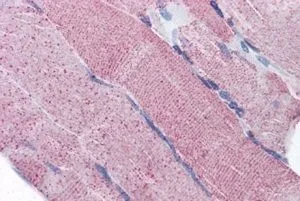
GTX88576
PACE4 antibody, Internal

Cannot supply to this region.
- SKU:
- GTX88576
- Additional Names:
- proprotein convertase subtilisin/kexin type 6 , PACE4 , SPC4
- Application:
- IHC-P
- Concentration:
- 0.50 mg/ml
- Physical State:
- Liquid
- Species Reactivity:
- Human
- Purification:
- Ammonium Sulfate Precipitated; Affinity Purified
- Storage Conditions:
- -20[o]C Aliquot. Avoid freeze/thaw cycles. Store undiluted., 2-8[o]C Aliquot. Avoid freeze/thaw cycles. Store undiluted., -20[o]C/-70[o]C Aliquot. Avoid freeze/thaw cycles. Store undiluted.
- Supplier:
- Genetex
- Host:
- Goat
- Reactivities:
- Human
- Buffer:
- TBS, 0.5% BSA, 0.02% Sodium azide.
- Immunogen:
- Peptide with sequence C-YHTFSAHQSRSR, from the internal region of the protein sequence according to NP_002561.1; NP_612192.1; NP_612195.1; NP_612197.1; NP_612196.1; NP_612198.2; NP_612193.1; NP_612194.1.
- Uniprot:
- P29122
- Synonyms:
- PACE4;paired basic amino acid cleaving enzyme 4;paired basic amino acid cleaving system 4;proprotein convertase subtilisin/kexin type 6;SPC4;subtilisin-like proprotein convertase 4;subtilisin/kexin-like protease PACE4
- Extra Details:
- This gene encodes a member of the subtilisin-like proprotein convertase family, which includes proteases that process protein and peptide precursors trafficking through regulated or constitutive branches of the secretory pathway. The encoded protein undergoes an initial autocatalytic processing event in the ER to generate a heterodimer which exits the ER and sorts to the trans-Golgi network where a second autocatalytic event takes place and the catalytic activity is acquired. The encoded protease is constitutively secreted into the extracellular matrix and expressed in many tissues, including neuroendocrine, liver, gut, and brain. This gene encodes one of the seven basic amino acid-specific members which cleave their substrates at single or paired basic residues. Some of its substrates include transforming growth factor beta related proteins, proalbumin, and von Willebrand factor. This gene is thought to play a role in tumor progression and left-right patterning. Alternatively spliced transcript variants encoding different isoforms have been identified. [provided by RefSeq, Feb 2014]
- Shipping Conditions:
- Blue Ice