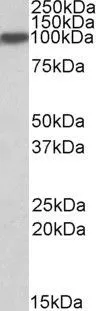
GTX88570
Aconitase 1 antibody, Internal

Cannot supply to this region.
- SKU:
- GTX88570
- Additional Names:
- aconitase 1 , ACONS , HEL60 , IREB1 , IREBP , IREBP1 , IRP1
- Application:
- WB
- Concentration:
- 0.50 mg/ml
- Physical State:
- Liquid
- Species Reactivity:
- Human
- Purification:
- Ammonium Sulfate Precipitated; Affinity Purified
- Storage Conditions:
- -20[o]C Aliquot. Avoid freeze/thaw cycles. Store undiluted., 2-8[o]C Aliquot. Avoid freeze/thaw cycles. Store undiluted., -20[o]C/-70[o]C Aliquot. Avoid freeze/thaw cycles. Store undiluted.
- Supplier:
- Genetex
- Host:
- Goat
- Reactivities:
- Human
- Buffer:
- TBS, 0.5% BSA, 0.02% Sodium azide.
- Immunogen:
- Peptide with sequence C-QVDFNRRADSLQKNQ, from the internal region of the protein sequence according to NP_002188.1.
- Uniprot:
- P21399
- Synonyms:
- aconitase 1, soluble;aconitate hydratase, cytoplasmic;ACONS;citrate hydro-lyase;cytoplasmic aconitase;cytoplasmic aconitate hydratase;cytosplasmic aconitase;epididymis luminal protein 60;epididymis secretory sperm binding protein;ferritin repressor protein;HEL60;IREB1;IREBP;IREBP1;iron regulatory protein 1;iron-responsive element-binding protein 1;IRP1;soluble aconitase
- Extra Details:
- The protein encoded by this gene is a bifunctional, cytosolic protein that functions as an essential enzyme in the TCA cycle and interacts with mRNA to control the levels of iron inside cells. When cellular iron levels are high, this protein binds to a 4Fe-4S cluster and functions as an aconitase. Aconitases are iron-sulfur proteins that function to catalyze the conversion of citrate to isocitrate. When cellular iron levels are low, the protein binds to iron-responsive elements (IREs), which are stem-loop structures found in the 5' UTR of ferritin mRNA, and in the 3' UTR of transferrin receptor mRNA. When the protein binds to IRE, it results in repression of translation of ferritin mRNA, and inhibition of degradation of the otherwise rapidly degraded transferrin receptor mRNA. The encoded protein has been identified as a moonlighting protein based on its ability to perform mechanistically distinct functions. Alternative splicing results in multiple transcript variants [provided by RefSeq, Jan 2014]
- Shipping Conditions:
- Blue Ice