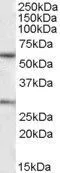
GTX88458
KCNQ1 antibody, C-term

Cannot supply to this region.
- SKU:
- GTX88458
- Additional Names:
- potassium voltage-gated channel subfamily Q member 1 , ATFB1 , ATFB3 , JLNS1 , KCNA8 , KCNA9 , KVLQT1 , Kv1.9 , Kv7.1 , LQT , LQT1 , RWS , SQT2 , WRS
- Application:
- WB
- Concentration:
- 0.50 mg/ml
- Physical State:
- Liquid
- Species Reactivity:
- Human
- Purification:
- Ammonium Sulfate Precipitated; Affinity Purified
- Storage Conditions:
- -20[o]C Aliquot. Avoid freeze/thaw cycles. Store undiluted., 2-8[o]C Aliquot. Avoid freeze/thaw cycles. Store undiluted., -20[o]C/-70[o]C Aliquot. Avoid freeze/thaw cycles. Store undiluted.
- Supplier:
- Genetex
- Host:
- Goat
- Reactivities:
- Human
- Buffer:
- TBS, 0.5% BSA, 0.02% Sodium azide.
- Immunogen:
- Peptide with sequence C-EQLTVPRRGPDEGS, from the C Terminus of the protein sequence according to NP_000209.2; NP_861463.1.
- Uniprot:
- P51787
- Synonyms:
- ATFB1;ATFB3;IKs producing slow voltage-gated potassium channel subunit alpha KvLQT1;JLNS1;KCNA8;KCNA9;kidney and cardiac voltage dependend K+ channel;KQT-like 1;Kv1.9;Kv7.1;KVLQT1;LQT;LQT1;potassium channel, voltage gated KQT-like subfamily Q, member 1;potassium voltage-gated channel subfamily KQT member 1;potassium voltage-gated channel, KQT-like subfamily, member 1;RWS;slow delayed rectifier channel subunit;SQT2;voltage-gated potassium channel subunit Kv7.1;WRS
- Extra Details:
- This gene encodes a voltage-gated potassium channel required for repolarization phase of the cardiac action potential. This protein can form heteromultimers with two other potassium channel proteins, KCNE1 and KCNE3. Mutations in this gene are associated with hereditary long QT syndrome 1 (also known as Romano-Ward syndrome), Jervell and Lange-Nielsen syndrome, and familial atrial fibrillation. This gene exhibits tissue-specific imprinting, with preferential expression from the maternal allele in some tissues, and biallelic expression in others. This gene is located in a region of chromosome 11 amongst other imprinted genes that are associated with Beckwith-Wiedemann syndrome (BWS), and itself has been shown to be disrupted by chromosomal rearrangements in patients with BWS. Alternatively spliced transcript variants have been found for this gene. [provided by RefSeq, Aug 2011]
- Shipping Conditions:
- Blue Ice