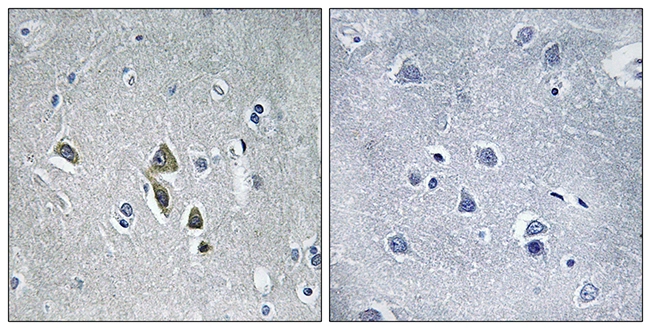
GTX87664
OAZ1 antibody

Cannot supply to this region.
- SKU:
- GTX87664
- Additional Names:
- AZI , OAZ , OAZ1 , ornithine decarboxylase antizyme 1
- Application:
- IHC-P
- Physical State:
- Liquid
- Species Reactivity:
- Human
- Purification:
- Affinity Purified
- Storage Conditions:
- -20[o]C Aliquot. Avoid freeze/thaw cycles. Store undiluted., 2-8[o]C Aliquot. Avoid freeze/thaw cycles. Store undiluted., -20[o]C/-70[o]C Aliquot. Avoid freeze/thaw cycles. Store undiluted.
- Supplier:
- Genetex
- Host:
- Rabbit
- Reactivities:
- Human
- Buffer:
- PBS, 150mM NaCl, 50% Glycerol, 0.02% Sodium azide.
- Immunogen:
- The antiserum was produced against synthesized peptide derived from human OAZ1 (14-63).
- Uniprot:
- P54368
- Synonyms:
- antizyme 1;AZ1;AZI;OAZ;ODC-Az;ornithine decarboxylase antizyme 1
- Extra Details:
- The protein encoded by this gene belongs to the ornithine decarboxylase antizyme family, which plays a role in cell growth and proliferation by regulating intracellular polyamine levels. Expression of antizymes requires +1 ribosomal frameshifting, which is enhanced by high levels of polyamines. Antizymes in turn bind to and inhibit ornithine decarboxylase (ODC), the key enzyme in polyamine biosynthesis; thus, completing the auto-regulatory circuit. This gene encodes antizyme 1, the first member of the antizyme family, that has broad tissue distribution, and negatively regulates intracellular polyamine levels by binding to and targeting ODC for degradation, as well as inhibiting polyamine uptake. Antizyme 1 mRNA contains two potential in-frame AUGs; and studies in rat suggest that alternative use of the two translation initiation sites results in N-terminally distinct protein isoforms with different subcellular localization. Alternatively spliced transcript variants have also been noted for this gene. [provided by RefSeq, Dec 2014]
- Shipping Conditions:
- Blue Ice