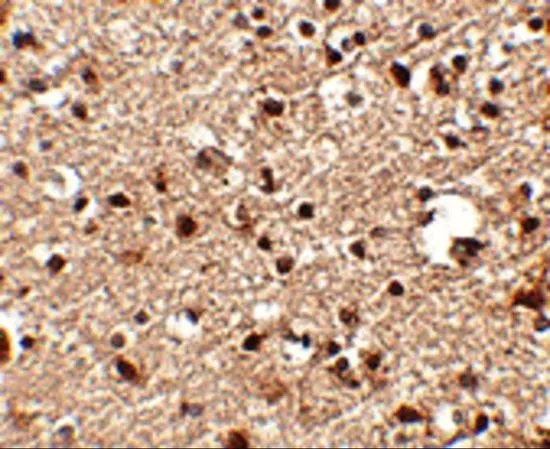
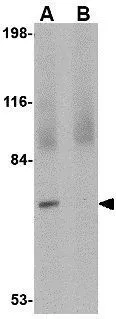
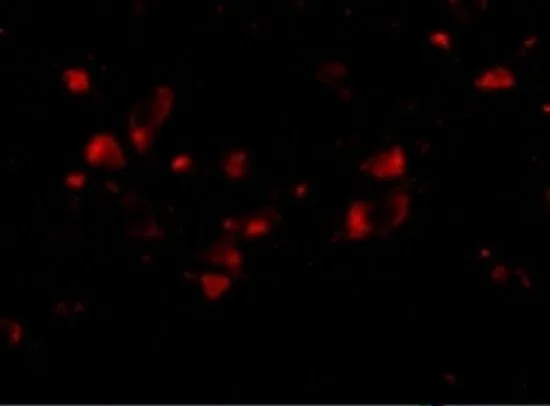
GTX85365
JPH4 antibody

Cannot supply to this region.
- SKU:
- GTX85365
- Additional Names:
- junctophilin 4 , JP4 , JPHL1
- Application:
- ELISA, WB, IHC-P
- Concentration:
- 1 mg/ml
- Physical State:
- Liquid
- Species Reactivity:
- Human
- Purification:
- Affinity Purified
- Storage Conditions:
- -20[o]C Aliquot. Avoid freeze/thaw cycles. Store undiluted., 2-8[o]C Aliquot. Avoid freeze/thaw cycles. Store undiluted., -20[o]C/-70[o]C Aliquot. Avoid freeze/thaw cycles. Store undiluted.
- Supplier:
- Genetex
- Host:
- Rabbit
- Reactivities:
- Human, Mouse, Rat
- Buffer:
- PBS, 0.02% Sodium azide.
- Immunogen:
- JPH4 antibody was raised against a 16 amino acid synthetic peptide near the carboxy terminus of human JPH4.The immunogen is located within amino acids 530 - 580 of JPH4.
- Uniprot:
- Q96JJ6
- Synonyms:
- JP-4;JP4;JPHL1;junctophilin like 1;junctophilin-4;junctophilin-like 1 protein
- Extra Details:
- Junctional complexes between the plasma membrane (PM) and endoplasmic/sarcoplasmic reticulum (ER/SR) are a common feature of all excitable cell types and mediate cross talk between cell surface and intracellular ion channels. Junctophilins (JPs) are important components of the junctional complexes. JPs are composed of a carboxy-terminal hydrophobic segment spanning the ER/SR membrane and a remaining cytoplasmic domain that shows specific affinity for the PM. Four JPs have been identified as tissue-specific subtypes derived from different genes: JPH1 is expressed in skeletal muscle, JPH2 is detected throughout all muscle cell types, and JPH3 and JPH4 are predominantly expressed in the brain. In the CNS, both JPH3 and JPH4 are expressed throughout neural sites and contribute to the subsurface cistern formation in neurons. Mice lacking both JPH3 and JPH4 subtypes exhibit serious symptoms such as impaired learning and memory and are accompanied by abnormal nervous functions.
- Shipping Conditions:
- Blue Ice