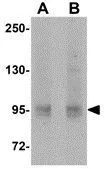
GTX85273
EphA10 antibody

Cannot supply to this region.
- SKU:
- GTX85273
- Additional Names:
- EPH receptor A10
- Application:
- ELISA, WB
- Concentration:
- 1 mg/ml
- Physical State:
- Liquid
- Species Reactivity:
- Human
- Purification:
- Affinity Purified
- Storage Conditions:
- -20[o]C Aliquot. Avoid freeze/thaw cycles. Store undiluted., 2-8[o]C Aliquot. Avoid freeze/thaw cycles. Store undiluted., -20[o]C/-70[o]C Aliquot. Avoid freeze/thaw cycles. Store undiluted.
- Supplier:
- Genetex
- Host:
- Rabbit
- Reactivities:
- Human, Mouse, Rat
- Buffer:
- PBS, 0.02% Sodium azide.
- Immunogen:
- EphA10 antibody was raised against a 14 amino acid synthetic peptide of near the amino terminus of human EphA10.The immunogen is located within amino acids 120 - 170 of EphA10.
- Uniprot:
- Q5JZY3
- Synonyms:
- EphA10s protein;ephrin type-A receptor 10
- Extra Details:
- Eph receptors, the largest subfamily of receptor tyrosine kinases (RTKs), and their ephrin ligands are important mediators of cell-cell communication regulating cell attachment, shape, and mobility of neuronal and endothelial cells in central nervous system function and in development. Eph receptors can be divided into two subgroups: EphA and EphB. In mammals, the EphA class consists of eight members (EphA 1-7 and 10) that in general bind to ephrin-A members linked to the cell membrane through a glycosylphosphatidylinositol linkage. The EphB class consists of six members (EphB 1-6) that in general bind ephrin-B members that transverse the cell membrane. The Ephrin / EPH signaling pathway networks with the WNT signaling pathway during embryogenesis, tissue regeneration, and carcinogenesis. Recent studies show that Eph/EFN might be relevant in normal B-cell biology and could represent new potential prognostic markers and therapeutic targets for CLL.
- Shipping Conditions:
- Blue Ice