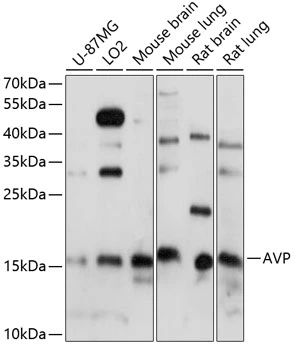
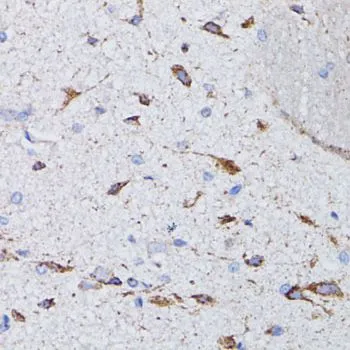
GTX66409
Vasopressin antibody

Cannot supply to this region.
- SKU:
- GTX66409
- Additional Names:
- arginine vasopressin , ADH , ARVP , AVP-NPII , AVRP , VP
- Application:
- WB, IHC-P
- Physical State:
- Liquid
- Species Reactivity:
- Human
- Purification:
- Affinity Purified
- Storage Conditions:
- -20[o]C Aliquot. Avoid freeze/thaw cycles. Store undiluted., 2-8[o]C Aliquot. Avoid freeze/thaw cycles. Store undiluted., -20[o]C/-70[o]C Aliquot. Avoid freeze/thaw cycles. Store undiluted.
- Supplier:
- Genetex
- Host:
- Rabbit
- Reactivities:
- Human, Mouse, Rat
- Buffer:
- PBS, 50% Glycerol, 0.02% Sodium azide.
- Immunogen:
- Recombinant funsion protein containing a sequence corresponding to amino acids 20-164 of human AVP (NP_000481.2).
- Uniprot:
- P01185
- Synonyms:
- ADH;antidiuretic hormone;ARVP;AVP-NPII;AVRP;copeptin;neurohypophyseal;prepro-arginine-vasopressin-neurophysin II;prepro-AVP-NP II;vasopressin-neurophysin 2-copeptin;vasopressin-neurophysin II-copeptin;VP
- Extra Details:
- This gene encodes a member of the vasopressin/oxytocin family and preproprotein that is proteolytically processed to generate multiple protein products. These products include the neuropeptide hormone arginine vasopressin, and two other peptides, neurophysin 2 and copeptin. Arginine vasopressin is a posterior pituitary hormone that is synthesized in the supraoptic nucleus and paraventricular nucleus of the hypothalamus. Along with its carrier protein, neurophysin 2, it is packaged into neurosecretory vesicles and transported axonally to the nerve endings in the neurohypophysis where it is either stored or secreted into the bloodstream. The precursor is thought to be activated while it is being transported along the axon to the posterior pituitary. Arginine vasopressin acts as a growth factor by enhancing pH regulation through acid-base transport systems. It has a direct antidiuretic action on the kidney, and also causes vasoconstriction of the peripheral vessels. This hormone can contract smooth muscle during parturition and lactation. It is also involved in cognition, tolerance, adaptation and complex sexual and maternal behaviour, as well as in the regulation of water excretion and cardiovascular functions. Mutations in this gene cause autosomal dominant neurohypophyseal diabetes insipidus (ADNDI). This gene is present in a gene cluster with the related gene oxytocin on chromosome 20. [provided by RefSeq, Nov 2015]
- Shipping Conditions:
- Blue Ice