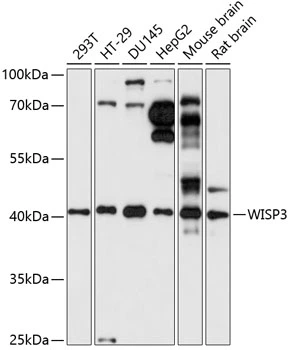
GTX66293
WISP3 antibody

Cannot supply to this region.
- SKU:
- GTX66293
- Additional Names:
- cellular communication network factor 6 , LIBC , PPAC , PPD , WISP-3 , WISP3
- Application:
- WB
- Physical State:
- Liquid
- Species Reactivity:
- Human
- Purification:
- Affinity Purified
- Storage Conditions:
- -20[o]C Aliquot. Avoid freeze/thaw cycles. Store undiluted., 2-8[o]C Aliquot. Avoid freeze/thaw cycles. Store undiluted., -20[o]C/-70[o]C Aliquot. Avoid freeze/thaw cycles. Store undiluted.
- Supplier:
- Genetex
- Host:
- Rabbit
- Reactivities:
- Human, Mouse, Rat
- Buffer:
- PBS, 50% Glycerol, 0.02% Sodium azide.
- Immunogen:
- Recombinant funsion protein containing a sequence corresponding to amino acids 42-260 of human WISP3 (NP_937882.1).
- Uniprot:
- O95389
- Synonyms:
- CCN family member 6;cellular communication network factor 6;epididymis secretory sperm binding protein;LIBC;PPAC;PPD;PPRD;WISP-3;WISP3;WNT1 inducible signaling pathway protein 3
- Extra Details:
- This gene encodes a member of the WNT1 inducible signaling pathway (WISP) protein subfamily, which belongs to the connective tissue growth factor (CTGF) family. WNT1 is a member of a family of cysteine-rich, glycosylated signaling proteins that mediate diverse developmental processes. The CTGF family members are characterized by four conserved cysteine-rich domains: insulin-like growth factor-binding domain, von Willebrand factor type C module, thrombospondin domain and C-terminal cystine knot-like domain. This gene is overexpressed in colon tumors. It may be downstream in the WNT1 signaling pathway that is relevant to malignant transformation. Mutations of this gene are associated with progressive pseudorheumatoid dysplasia, an autosomal recessive skeletal disorder, indicating that the gene is essential for normal postnatal skeletal growth and cartilage homeostasis. Multiple transcript variants encoding different isoforms have been found for this gene. [provided by RefSeq, Jul 2008]
- Shipping Conditions:
- Blue Ice