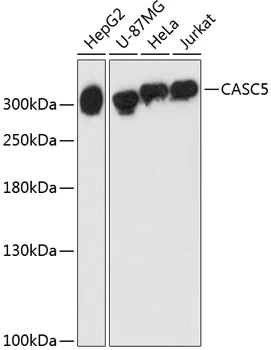
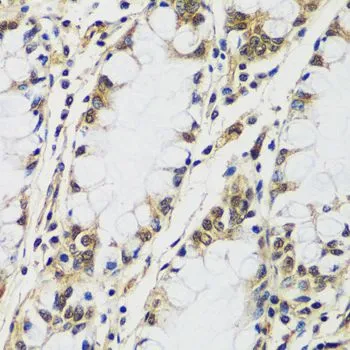
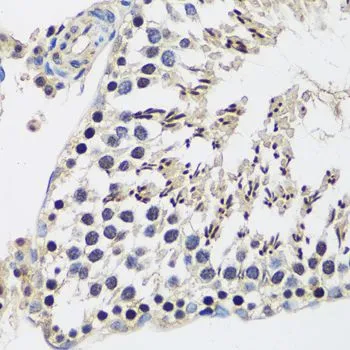
GTX66163
CASC5 antibody

Cannot supply to this region.
- SKU:
- GTX66163
- Additional Names:
- kinetochore scaffold 1 , AF15Q14 , CASC5 , CT29 , D40 , MCPH4 , PPP1R55 , Spc7 , hKNL-1 , hSpc105
- Application:
- WB, IHC-P
- Physical State:
- Liquid
- Species Reactivity:
- Human
- Purification:
- Affinity Purified
- Storage Conditions:
- -20[o]C Aliquot. Avoid freeze/thaw cycles. Store undiluted., 2-8[o]C Aliquot. Avoid freeze/thaw cycles. Store undiluted., -20[o]C/-70[o]C Aliquot. Avoid freeze/thaw cycles. Store undiluted.
- Supplier:
- Genetex
- Host:
- Rabbit
- Reactivities:
- Human, Rat
- Buffer:
- PBS, 50% Glycerol, 0.02% Sodium azide.
- Immunogen:
- Recombinant funsion protein containing a sequence corresponding to amino acids 1-300 of human CASC5 (NP_733468.3).
- Uniprot:
- Q8NG31
- Synonyms:
- AF15Q14;ALL1-fused gene from chromosome 15q14 protein;blinkin, bub-linking kinetochore protein;Bub-linking kinetochore protein;cancer susceptibility candidate 5;cancer susceptibility candidate gene 5 protein;cancer/testis antigen 29;CASC5;CT29;D40;hKNL-1;hSpc105;kinetochore null 1 homolog;kinetochore scaffold 1;kinetochore-null protein 1;MCPH4;microcephaly, primary autosomal recessive 4;PPP1R55;Protein CASC5;Protein D40/AF15q14;protein phosphatase 1, regulatory subunit 55;Spc7
- Extra Details:
- The protein encoded by this gene is a component of the multiprotein assembly that is required for creation of kinetochore-microtubule attachments and chromosome segregation. The encoded protein functions as a scaffold for proteins that influence the spindle assembly checkpoint during the eukaryotic cell cycle and it interacts with at least five different kinetochore proteins and two checkpoint kinases. In adults, this gene is predominantly expressed in normal testes, various cancer cell lines and primary tumors from other tissues and is ubiquitously expressed in fetal tissues. This gene was originally identified as a fusion partner with the mixed-lineage leukemia (MLL) gene in t(11;15)(q23;q14). Mutations in this gene cause autosomal recessive primary microcephaly-4 (MCPH4). Alternative splicing results in multiple transcript variants encoding different isoforms. Additional splice variants have been described but their biological validity has not been confirmed. [provided by RefSeq, Jan 2013]
- Shipping Conditions:
- Blue Ice