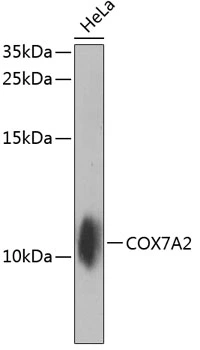
GTX64639
COX7A2 antibody

Cannot supply to this region.
- SKU:
- GTX64639
- Additional Names:
- cytochrome c oxidase subunit 7A2 , COX7AL , COX7AL1 , COXVIIAL , COXVIIa-L , VIIAL
- Application:
- WB
- Physical State:
- Liquid
- Species Reactivity:
- Human
- Purification:
- Affinity Purified
- Storage Conditions:
- -20[o]C Aliquot. Avoid freeze/thaw cycles. Store undiluted., 2-8[o]C Aliquot. Avoid freeze/thaw cycles. Store undiluted., -20[o]C/-70[o]C Aliquot. Avoid freeze/thaw cycles. Store undiluted.
- Supplier:
- Genetex
- Host:
- Rabbit
- Reactivities:
- Human
- Buffer:
- PBS, 50% Glycerol, 0.02% Sodium azide.
- Immunogen:
- Recombinant fusion protein containing a sequence corresponding to amino acids 33-115 of human COX7A2 (NP_001856.2).
- Uniprot:
- P14406
- Synonyms:
- COX7AL;COX7AL1;COXVIIa-L;COXVIIAL;cytochrome c oxidase polypeptide 7A2, mitochondrial;cytochrome c oxidase polypeptide VIIa-liver/heart;cytochrome c oxidase subunit 7A2, mitochondrial;cytochrome c oxidase subunit VIIa polypeptide 2 (liver);cytochrome c oxidase subunit VIIa-L;cytochrome c oxidase subunit VIIa-liver/heart;cytochrome c oxidase subunit VIIaL;hepatic cytochrome-c oxidase chain VIIa;VIIAL
- Extra Details:
- Cytochrome c oxidase, the terminal component of the mitochondrial respiratory chain, catalyzes the electron transfer from reduced cytochrome c to oxygen. This component is a heteromeric complex consisting of three catalytic subunits encoded by mitochondrial genes, and multiple structural subunits encoded by nuclear genes. The mitochondrially-encoded subunits function in electron transfer, while the nuclear-encoded subunits may function in the regulation and assembly of the complex. This nuclear gene encodes polypeptide 2 (liver isoform) of subunit VIIa, with this polypeptide being present in both muscle and non-muscle tissues. In addition to polypeptide 2, subunit VIIa includes polypeptide 1 (muscle isoform), which is present only in muscle tissues, and a related protein, which is present in all tissues. Alternative splicing results in multiple transcript variants. Related pseudogenes have been identified on chromosomes 4 and 14. [provided by RefSeq, Oct 2009]
- Shipping Conditions:
- Blue Ice