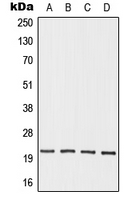
GTX55956
OAZ3 antibody

Cannot supply to this region.
- SKU:
- GTX55956
- Additional Names:
- ornithine decarboxylase antizyme 3 , AZ3 , OAZ-t , TISP15
- Application:
- WB
- Physical State:
- Liquid
- Species Reactivity:
- Human
- Purification:
- Affinity Purified
- Storage Conditions:
- -20[o]C Aliquot. Avoid freeze/thaw cycles. Store undiluted., 2-8[o]C Aliquot. Avoid freeze/thaw cycles. Store undiluted., -20[o]C/-70[o]C Aliquot. Avoid freeze/thaw cycles. Store undiluted.
- Supplier:
- Genetex
- Host:
- Rabbit
- Reactivities:
- Human, Mouse, Rat
- Buffer:
- 0.42% Potassium Phosphate, 0.87% NaCl, 30% Glycerol, 0.01% Sodium azide.
- Immunogen:
- KLH-conjugated synthetic peptide encompassing a sequence within the center region of OAZ3. The exact sequence is proprietary.
- Uniprot:
- Q9UMX2
- Synonyms:
- antizyme 3;AZ3;OAZ-t;ODC-Az 3;ornithine decarboxylase antizyme 3;testicular secretory protein Li 31;TISP15
- Extra Details:
- The protein encoded by this gene belongs to the ornithine decarboxylase antizyme family, which plays a role in cell growth and proliferation by regulating intracellular polyamine levels. Expression of antizymes requires +1 ribosomal frameshifting, which is enhanced by high levels of polyamines. Antizymes in turn bind to and inhibit ornithine decarboxylase (ODC), the key enzyme in polyamine biosynthesis; thus, completing the auto-regulatory circuit. This gene encodes antizyme 3, the third member of the antizyme family. Like antizymes 1 and 2, antizyme 3 inhibits ODC activity and polyamine uptake; however, it does not stimulate ODC degradation. Also, while antizymes 1 and 2 have broad tissue distribution, expression of antizyme 3 is restricted to haploid germ cells in testis, suggesting a distinct role for this antizyme in spermiogenesis. Antizyme 3 gene knockout studies showed that homozygous mutant male mice were infertile, and indicated the likely role of this antizyme in the formation of a rigid connection between the sperm head and tail during spermatogenesis. Alternatively spliced transcript variants encoding different isoforms, including one resulting from the use of non-AUG (CUG) translation initiation codon, have been found for this gene. [provided by RefSeq, Dec 2014]
- Shipping Conditions:
- Blue Ice