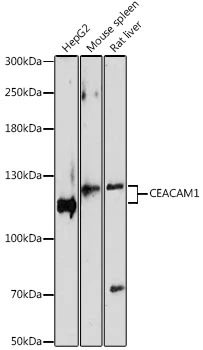
GTX55568
CEACAM1 antibody

Cannot supply to this region.
- SKU:
- GTX55568
- Additional Names:
- carcinoembryonic antigen related cell adhesion molecule 1 , BGP , BGP1 , BGPI
- Application:
- WB
- Physical State:
- Liquid
- Species Reactivity:
- Human
- Purification:
- Affinity Purified
- Storage Conditions:
- -20[o]C Aliquot. Avoid freeze/thaw cycles. Store undiluted., 2-8[o]C Aliquot. Avoid freeze/thaw cycles. Store undiluted., -20[o]C/-70[o]C Aliquot. Avoid freeze/thaw cycles. Store undiluted.
- Supplier:
- Genetex
- Host:
- Rabbit
- Reactivities:
- Human, Mouse, Rat
- Buffer:
- PBS, 50% Glycerol, 0.02% Sodium azide.
- Immunogen:
- Recombinant fusion protein containing a sequence corresponding to amino acids 300-430 of human CEACAM1 (NP_001192273.1).
- Uniprot:
- P13688
- Synonyms:
- antigen CD66;BGP;BGP1;BGPI;Biliary glycoprotein 1;carcinoembryonic antigen related cell adhesion molecule 1;carcinoembryonic antigen-related cell adhesion molecule 1;carcinoembryonic antigen-related cell adhesion molecule 1 (biliary glycoprotein);CD66a antigen
- Extra Details:
- This gene encodes a member of the carcinoembryonic antigen (CEA) gene family, which belongs to the immunoglobulin superfamily. Two subgroups of the CEA family, the CEA cell adhesion molecules and the pregnancy-specific glycoproteins, are located within a 1.2 Mb cluster on the long arm of chromosome 19. Eleven pseudogenes of the CEA cell adhesion molecule subgroup are also found in the cluster. The encoded protein was originally described in bile ducts of liver as biliary glycoprotein. Subsequently, it was found to be a cell-cell adhesion molecule detected on leukocytes, epithelia, and endothelia. The encoded protein mediates cell adhesion via homophilic as well as heterophilic binding to other proteins of the subgroup. Multiple cellular activities have been attributed to the encoded protein, including roles in the differentiation and arrangement of tissue three-dimensional structure, angiogenesis, apoptosis, tumor suppression, metastasis, and the modulation of innate and adaptive immune responses. Multiple transcript variants encoding different isoforms have been reported, but the full-length nature of all variants has not been defined. [provided by RefSeq, May 2010]
- Shipping Conditions:
- Blue Ice