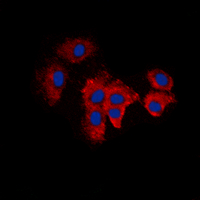
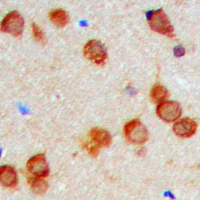
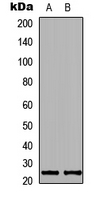
GTX55288
KDELR2 antibody

Cannot supply to this region.
- SKU:
- GTX55288
- Additional Names:
- KDEL endoplasmic reticulum protein retention receptor 2 , ELP-1 , ERD2.2
- Application:
- WB, IHC-P, IF, ICC
- Physical State:
- Liquid
- Species Reactivity:
- Human
- Purification:
- Affinity Purified
- Storage Conditions:
- -20[o]C Aliquot. Avoid freeze/thaw cycles. Store undiluted., 2-8[o]C Aliquot. Avoid freeze/thaw cycles. Store undiluted., -20[o]C/-70[o]C Aliquot. Avoid freeze/thaw cycles. Store undiluted.
- Supplier:
- Genetex
- Host:
- Rabbit
- Reactivities:
- Human, Mouse
- Buffer:
- 0.42% Potassium Phosphate, 0.87% NaCl, 30% Glycerol, 0.01% Sodium azide.
- Immunogen:
- KLH-conjugated synthetic peptide encompassing a sequence within the center region of KDELR2. The exact sequence is proprietary.
- Uniprot:
- P33947
- Synonyms:
- (Lys-Asp-Glu-Leu) endoplasmic reticulum protein retention receptor 2;ELP-1;ELP1;ER lumen protein-retaining receptor 2;ERD-2-like protein;ERD2-like protein 1;ERD2.2;KDEL (Lys-Asp-Glu-Leu) endoplasmic reticulum protein retention receptor 2;KDEL endoplasmic reticulum protein retention receptor 2;KDEL receptor 2;OI21
- Extra Details:
- Retention of resident soluble proteins in the lumen of the endoplasmic reticulum (ER) is achieved in both yeast and animal cells by their continual retrieval from the cis-Golgi, or a pre-Golgi compartment. Sorting of these proteins is dependent on a C-terminal tetrapeptide signal, usually lys-asp-glu-leu (KDEL) in animal cells, and his-asp-glu-leu (HDEL) in S. cerevisiae. This process is mediated by a receptor that recognizes, and binds the tetrapeptide-containing protein, and returns it to the ER. In yeast, the sorting receptor encoded by a single gene, ERD2, is a seven-transmembrane protein. Unlike yeast, several human homologs of the ERD2 gene, constituting the KDEL receptor gene family, have been described. KDELR2 was the second member of the family to be identified, and it encodes a protein which is 83% identical to the KDELR1 gene product. Alternative splicing results in multiple transcript variants encoding distinct isoforms. [provided by RefSeq, Jul 2008]
- Shipping Conditions:
- Blue Ice