GTX54905
c-Abl antibody

Cannot supply to this region.
- SKU:
- GTX54905
- Additional Names:
- ABL proto-oncogene 1, non-receptor tyrosine kinase , ABL , CHDSKM , JTK7 , bcr/abl , c-ABL , c-ABL1 , p150 , v-abl
- Application:
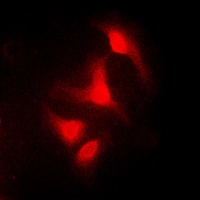
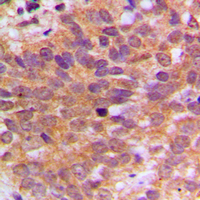
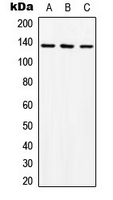
- WB, IHC-P, IF, ICC
- Physical State:
- Liquid
- Species Reactivity:
- Human
- Purification:
- Affinity Purified
- Storage Conditions:
- -20[o]C Aliquot. Avoid freeze/thaw cycles. Store undiluted., 2-8[o]C Aliquot. Avoid freeze/thaw cycles. Store undiluted., -20[o]C/-70[o]C Aliquot. Avoid freeze/thaw cycles. Store undiluted.
- Supplier:
- Genetex
- Host:
- Rabbit
- Reactivities:
- Human, Mouse, Rat
- Buffer:
- 0.42% Potassium Phosphate, 0.87% NaCl, 30% Glycerol, 0.01% Sodium azide.
- Immunogen:
- KLH-conjugated synthetic peptide encompassing a sequence within the C-term region of c-Abl. The exact sequence is proprietary.
- Uniprot:
- P00519
- Synonyms:
- Abelson murine leukemia viral oncogene homolog 1;Abelson tyrosine-protein kinase 1;ABL;ABL protooncogene 1 nonreceptor tyrosine kinase;BCR-ABL;bcr/abl;bcr/c-abl oncogene protein;c-ABL;c-abl oncogene 1, receptor tyrosine kinase;c-ABL1;CHDSKM;JTK7;p150;proto-oncogene c-Abl;proto-oncogene tyrosine-protein kinase ABL1;truncated ABL protooncogene 1 nonreceptor tyrosine kinase;tyrosine-protein kinase ABL1;v-abl;v-abl Abelson murine leukemia viral oncogene homolog 1
- Extra Details:
- This gene is a protooncogene that encodes a protein tyrosine kinase involved in a variety of cellular processes, including cell division, adhesion, differentiation, and response to stress. The activity of the protein is negatively regulated by its SH3 domain, whereby deletion of the region encoding this domain results in an oncogene. The ubiquitously expressed protein has DNA-binding activity that is regulated by CDC2-mediated phosphorylation, suggesting a cell cycle function. This gene has been found fused to a variety of translocation partner genes in various leukemias, most notably the t(9;22) translocation that results in a fusion with the 5' end of the breakpoint cluster region gene (BCR; MIM:151410). Alternative splicing of this gene results in two transcript variants, which contain alternative first exons that are spliced to the remaining common exons. [provided by RefSeq, Aug 2014]
- Shipping Conditions:
- Blue Ice