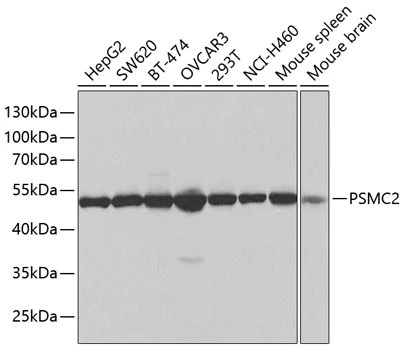
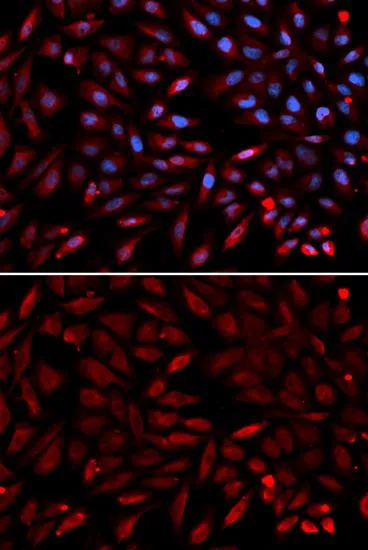
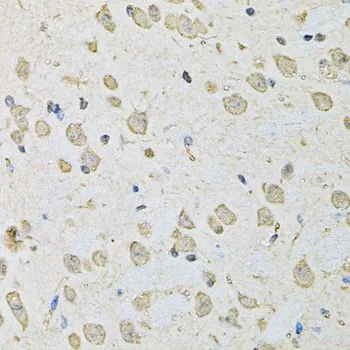
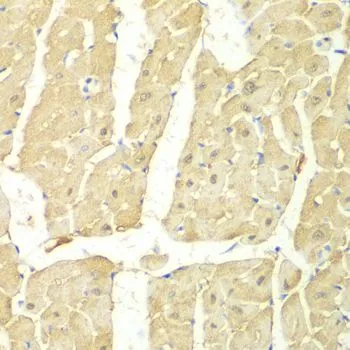
GTX54583
PSMC2 antibody

Cannot supply to this region.
- SKU:
- GTX54583
- Additional Names:
- proteasome 26S subunit, ATPase 2 , MSS1 , Nbla10058 , S7
- Application:
- WB, IHC-P, IF, ICC
- Physical State:
- Liquid
- Species Reactivity:
- Human
- Purification:
- Affinity Purified
- Storage Conditions:
- -20[o]C Aliquot. Avoid freeze/thaw cycles. Store undiluted., 2-8[o]C Aliquot. Avoid freeze/thaw cycles. Store undiluted., -20[o]C/-70[o]C Aliquot. Avoid freeze/thaw cycles. Store undiluted.
- Supplier:
- Genetex
- Host:
- Rabbit
- Reactivities:
- Human, Mouse
- Buffer:
- PBS, 50% Glycerol, 0.02% Sodium azide.
- Immunogen:
- Recombinant fusion protein containing a sequence corresponding to amino acids 1-160 of human PSMC2 (NP_002794.1).
- Uniprot:
- P35998
- Synonyms:
- 26S protease regulatory subunit 7;26S proteasome AAA-ATPase subunit RPT1;26S proteasome regulatory subunit 7;mammalian suppressor of sgv-1 of yeast;MSS1;Nbla10058;protease 26S subunit 7;proteasome (prosome, macropain) 26S subunit, ATPase, 2;Proteasome 26S subunit ATPase 2;Protein MSS1;putative protein product of Nbla10058;RPT1;S7;testis secretory sperm-binding protein Li 197a
- Extra Details:
- The 26S proteasome is a multicatalytic proteinase complex with a highly ordered structure composed of 2 complexes, a 20S core and a 19S regulator. The 20S core is composed of 4 rings of 28 non-identical subunits; 2 rings are composed of 7 alpha subunits and 2 rings are composed of 7 beta subunits. The 19S regulator is composed of a base, which contains 6 ATPase subunits and 2 non-ATPase subunits, and a lid, which contains up to 10 non-ATPase subunits. Proteasomes are distributed throughout eukaryotic cells at a high concentration and cleave peptides in an ATP/ubiquitin-dependent process in a non-lysosomal pathway. An essential function of a modified proteasome, the immunoproteasome, is the processing of class I MHC peptides. This gene encodes one of the ATPase subunits, a member of the triple-A family of ATPases which have a chaperone-like activity. This subunit has been shown to interact with several of the basal transcription factors so, in addition to participation in proteasome functions, this subunit may participate in the regulation of transcription. This subunit may also compete with PSMC3 for binding to the HIV tat protein to regulate the interaction between the viral protein and the transcription complex. Alternative splicing results in multiple transcript variants encoding distinct isoforms. [provided by RefSeq, Mar 2011]
- Shipping Conditions:
- Blue Ice