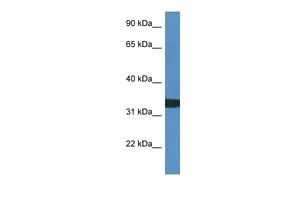
GTX48935
ACER1 antibody, C-term

Cannot supply to this region.
- SKU:
- GTX48935
- Additional Names:
- alkaline ceramidase 1 , ALKCDase1 , ASAH3
- Application:
- WB
- Concentration:
- 0.5-1 mg/ml
- Physical State:
- Liquid
- Species Reactivity:
- Human
- Purification:
- Affinity Purified
- Storage Conditions:
- -20[o]C Aliquot. Avoid freeze/thaw cycles. Store undiluted., 2-8[o]C Aliquot. Avoid freeze/thaw cycles. Store undiluted., -20[o]C/-70[o]C Aliquot. Avoid freeze/thaw cycles. Store undiluted.
- Supplier:
- Genetex
- Host:
- Rabbit
- Reactivities:
- Human
- Buffer:
- PBS, 2% Sucrose, 0.09% Sodium azide.
- Immunogen:
- A synthetic peptide corresponding to a C-terminal region of Human ACER1
- Uniprot:
- Q8TDN7
- Synonyms:
- acylsphingosine deacylase 3;alkaline CDase 1;alkaline ceramidase 1;alkCDase 1;ALKCDase1;ASAH3;CTB-180A7.3;N-acylsphingosine amidohydrolase (alkaline ceramidase) 3;N-acylsphingosine amidohydrolase 3
- Extra Details:
- Ceramides are synthesized during epidermal differentiation and accumulate within the interstices of the stratum corneum, where they represent critical components of the epidermal permeability barrier. Excess cellular ceramide can trigger antimitogenic signals and induce apoptosis, and the ceramide metabolites sphingosine and sphingosine-1-phosphate (S1P) are important bioregulatory molecules. Ceramide hydrolysis in the nucleated cell layers regulates keratinocyte proliferation and apoptosis in response to external stress. Ceramide hydrolysis also occurs at the stratum corneum, releasing free sphingoid base that functions as an endogenous antimicrobial agent. ACER1 is highly expressed in epidermis and catalyzes the hydrolysis of very long chain ceramides to generate sphingosine (Houben et al., 2006 [PubMed 16477081]; Sun et al., 2008 [PubMed 17713573]).[supplied by OMIM, Jul 2010]
- Shipping Conditions:
- Blue Ice