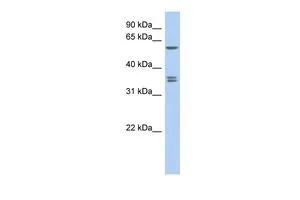
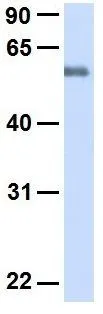
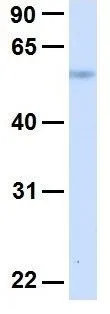
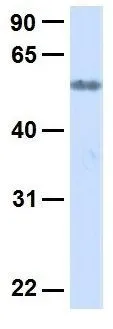
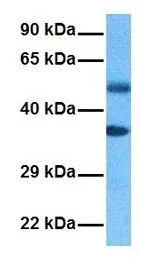
GTX46980
SLC19A3 antibody, Internal

Cannot supply to this region.
- SKU:
- GTX46980
- Additional Names:
- solute carrier family 19 member 3 , BBGD , THMD2 , THTR2
- Application:
- WB
- Concentration:
- 0.5-1 mg/ml
- Physical State:
- Liquid
- Species Reactivity:
- Human
- Purification:
- Affinity Purified
- Storage Conditions:
- -20[o]C Aliquot. Avoid freeze/thaw cycles. Store undiluted., 2-8[o]C Aliquot. Avoid freeze/thaw cycles. Store undiluted., -20[o]C/-70[o]C Aliquot. Avoid freeze/thaw cycles. Store undiluted.
- Supplier:
- Genetex
- Host:
- Rabbit
- Reactivities:
- Human
- Buffer:
- PBS, 2% Sucrose, 0.09% Sodium azide.
- Immunogen:
- A synthetic peptide corresponding to an Internal region of Human SLC19A3
- Uniprot:
- Q9BZV2
- Synonyms:
- BBGD;solute carrier family 19 (thiamine transporter), member 3;Solute carrier family 19 member 3;thiamine transporter 2;THMD2;thTr-2;THTR2
- Extra Details:
- This gene encodes a ubiquitously expressed transmembrane thiamine transporter that lacks folate transport activity. Mutations in this gene cause biotin-responsive basal ganglia disease (BBGD); a recessive disorder manifested in childhood that progresses to chronic encephalopathy, dystonia, quadriparesis, and death if untreated. Patients with BBGD have bilateral necrosis in the head of the caudate nucleus and in the putamen. Administration of high doses of biotin in the early progression of the disorder eliminates pathological symptoms while delayed treatment results in residual paraparesis, mild cognitive disability, or dystonia. Administration of thiamine is ineffective in the treatment of this disorder. Experiments have failed to show that this protein can transport biotin. Mutations in this gene also cause a Wernicke's-like encephalopathy.[provided by RefSeq, Jan 2010]
- Shipping Conditions:
- Blue Ice