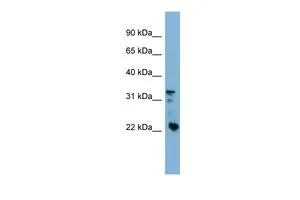
GTX45811
CRYBB3 antibody, Internal

Cannot supply to this region.
- SKU:
- GTX45811
- Additional Names:
- crystallin beta B3 , CATCN2 , CRYB3 , CTRCT22
- Application:
- WB
- Concentration:
- 0.5-1 mg/ml
- Physical State:
- Liquid
- Species Reactivity:
- Human
- Purification:
- Affinity Purified
- Storage Conditions:
- -20[o]C Aliquot. Avoid freeze/thaw cycles. Store undiluted., 2-8[o]C Aliquot. Avoid freeze/thaw cycles. Store undiluted., -20[o]C/-70[o]C Aliquot. Avoid freeze/thaw cycles. Store undiluted.
- Supplier:
- Genetex
- Host:
- Rabbit
- Reactivities:
- Human
- Buffer:
- PBS, 2% Sucrose, 0.09% Sodium azide.
- Immunogen:
- A synthetic peptide corresponding to an Internal region of Human CRYBB3
- Uniprot:
- P26998
- Synonyms:
- Beta-B3 crystallin;beta-crystallin B3;CATCN2;CRYB3;CTRCT22;eye lens structural protein
- Extra Details:
- Crystallins are separated into two classes: taxon-specific, or enzyme, and ubiquitous. The latter class constitutes the major proteins of vertebrate eye lens and maintains the transparency and refractive index of the lens. Since lens central fiber cells lose their nuclei during development, these crystallins are made and then retained throughout life, making them extremely stable proteins. Mammalian lens crystallins are divided into alpha, beta, and gamma families; beta and gamma crystallins are also considered as a superfamily. Alpha and beta families are further divided into acidic and basic groups. Seven protein regions exist in crystallins: four homologous motifs, a connecting peptide, and N- and C-terminal extensions. Beta-crystallins, the most heterogeneous, differ by the presence of the C-terminal extension (present in the basic group, none in the acidic group). Beta-crystallins form aggregates of different sizes and are able to self-associate to form dimers or to form heterodimers with other beta-crystallins. This gene, a beta basic group member, is part of a gene cluster with beta-A4, beta-B1, and beta-B2. Mutations in this gene result in cataract congenital nuclear autosomal recessive type 2. [provided by RefSeq, Feb 2013]
- Shipping Conditions:
- Blue Ice