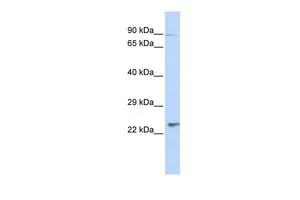
GTX45273
LRRC51 antibody, N-term

Cannot supply to this region.
- SKU:
- GTX45273
- Additional Names:
- leucine rich transmembrane and O-methyltransferase domain containing , CFAP111 , DFNB63 , LRRC51
- Application:
- WB
- Concentration:
- 0.5-1 mg/ml
- Physical State:
- Liquid
- Species Reactivity:
- Human
- Purification:
- Affinity Purified
- Storage Conditions:
- -20[o]C Aliquot. Avoid freeze/thaw cycles. Store undiluted., 2-8[o]C Aliquot. Avoid freeze/thaw cycles. Store undiluted., -20[o]C/-70[o]C Aliquot. Avoid freeze/thaw cycles. Store undiluted.
- Supplier:
- Genetex
- Host:
- Rabbit
- Reactivities:
- Human
- Buffer:
- PBS, 2% Sucrose, 0.09% Sodium azide.
- Immunogen:
- A synthetic peptide corresponding to a N-terminal region of Human LRRC51
- Uniprot:
- Q8WZ04, Q96E66
- Synonyms:
- Catechol O-methyltransferase 2;CFAP111;DFNB63;leucine rich transmembrane and 0-methyltransferase domain containing;LRRC51;Protein LRTOMT1;Protein LRTOMT2;transmembrane O-methyltransferase
- Extra Details:
- This gene has evolved in primates as a fusion of two ancestral neighboring genes, Lrrc51 and Tomt, which exist as two independent genes in rodents. The fusion gene contains some shared exons, but encodes structurally unrelated proteins, LRTOMT1 and LRTOMT2. Those variants that utilize the more centromere-proximal 3' terminal exon (short transcript form) encode LRTOMT1, while those variants that use a more centromere-distal 3' terminal exon (long transcript form) encode the LRTOMT2 protein. There is a small region within one of the exons of this gene that contains overlapping alternate reading frames for both LRTOMT1 and LRTOMT2. LRTOMT1 shares similarity with the protein encoded by mouse Lrrc51, while LRTOMT2 shares similarity with the protein encoded by mouse Tomt. Alternative splicing results in multiple transcript variants, encoding different isoforms of both LRTOMT1 and LRTOMT2. The LRTOMT1 protein is a leucine-rich repeat-containing protein, while the LRTOMT2 protein is a catechol-O-methyltransferase that catalyzes the transfer of a methyl group from S-adenosyl-L-methionine to a hydroxyl group of catechols and is essential for auditory and vestibular function. Mutations in this gene have been associated with nonsyndromic deafness. [provided by RefSeq, Nov 2017]
- Shipping Conditions:
- Blue Ice