GTX35239
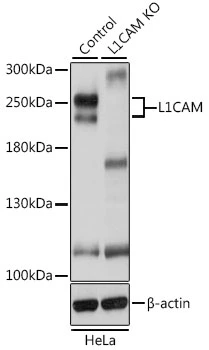
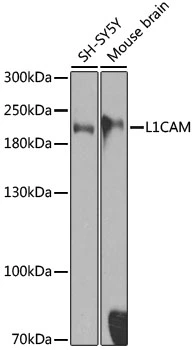
L1CAM antibody

Cannot supply to this region.
- SKU:
- GTX35239
- Additional Names:
- L1 cell adhesion molecule , CAML1 , CD171 , HSAS , HSAS1 , MASA , MIC5 , N-CAM-L1 , N-CAML1 , NCAM-L1 , S10 , SPG1
- Application:
- WB
- Physical State:
- Liquid
- Species Reactivity:
- Human
- Purification:
- Affinity Purified
- Storage Conditions:
- -20[o]C Aliquot. Avoid freeze/thaw cycles. Store undiluted., 2-8[o]C Aliquot. Avoid freeze/thaw cycles. Store undiluted., -20[o]C/-70[o]C Aliquot. Avoid freeze/thaw cycles. Store undiluted.
- Supplier:
- Genetex
- Host:
- Rabbit
- Reactivities:
- Human, Mouse
- Buffer:
- PBS, 50% Glycerol, 0.02% Sodium azide.
- Immunogen:
- Recombinant fusion protein containing a sequence corresponding to amino acids 1143-1257 of human L1CAM (NP_000416.1).
- Uniprot:
- P32004
- Synonyms:
- antigen identified by monoclonal antibody R1;CAML1;CD171;HSAS;HSAS1;MASA;MIC5;N-CAM-L1;N-CAML1;NCAM-L1;neural cell adhesion molecule L1;S10;SPG1
- Extra Details:
- The protein encoded by this gene is an axonal glycoprotein belonging to the immunoglobulin supergene family. The ectodomain, consisting of several immunoglobulin-like domains and fibronectin-like repeats (type III), is linked via a single transmembrane sequence to a conserved cytoplasmic domain. This cell adhesion molecule plays an important role in nervous system development, including neuronal migration and differentiation. Mutations in the gene cause X-linked neurological syndromes known as CRASH (corpus callosum hypoplasia, retardation, aphasia, spastic paraplegia and hydrocephalus). Alternative splicing of this gene results in multiple transcript variants, some of which include an alternate exon that is considered to be specific to neurons. [provided by RefSeq, May 2013]
- Shipping Conditions:
- Blue Ice