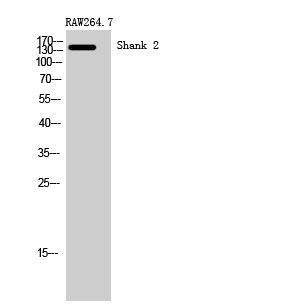
GTX34197
SHANK2 antibody

Cannot supply to this region.
- SKU:
- GTX34197
- Additional Names:
- AUTS17,CORTBP1,CTTNBP1,ProSAP1,SH3 and multiple ankyrin repeat domains 2,SHANK,SHANK2,SPANK3
- Application:
- WB
- Concentration:
- 1 mg/ml
- Physical State:
- Liquid
- Species Reactivity:
- Human, Mouse
- Purification:
- Affinity Purified
- Storage Conditions:
- -20[o]C Aliquot. Avoid freeze/thaw cycles. Store undiluted., 2-8[o]C Aliquot. Avoid freeze/thaw cycles. Store undiluted., -20[o]C/-70[o]C Aliquot. Avoid freeze/thaw cycles. Store undiluted.
- Supplier:
- Genetex
- Host:
- Rabbit
- Reactivities:
- Mouse
- Buffer:
- PBS, 0.5% BSA, 50% Glycerol, 0.02% Sodium azide.
- Immunogen:
- Synthesized peptide derived from human Shank 2 at 300-380 aa, Internal.
- Uniprot:
- Q9UPX8
- Synonyms:
- AUTS17;cortactin SH3 domain-binding protein;cortactin-binding protein 1;CORTBP1;CTTNBP1;GKAP/SAPAP interacting protein;proline-rich synapse associated protein 1;Proline-rich synapse-associated protein 1;ProSAP1;SH3 and multiple ankyrin repeat domains protein 2;SHANK;SPANK-3
- Extra Details:
- This gene encodes a protein that is a member of the Shank family of synaptic proteins that may function as molecular scaffolds in the postsynaptic density of excitatory synapses. Shank proteins contain multiple domains for protein-protein interaction, including ankyrin repeats, and an SH3 domain. This particular family member contains a PDZ domain, a consensus sequence for cortactin SH3 domain-binding peptides and a sterile alpha motif. The alternative splicing demonstrated in Shank genes has been suggested as a mechanism for regulating the molecular structure of Shank and the spectrum of Shank-interacting proteins in the postsynaptic densities of the adult and developing brain. Alterations in the encoded protein may be associated with susceptibility to autism spectrum disorder. Alternative splicing results in multiple transcript variants. [provided by RefSeq, Feb 2014]
- Shipping Conditions:
- Blue Ice