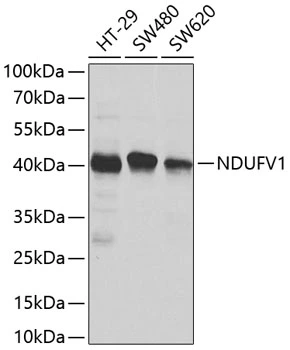
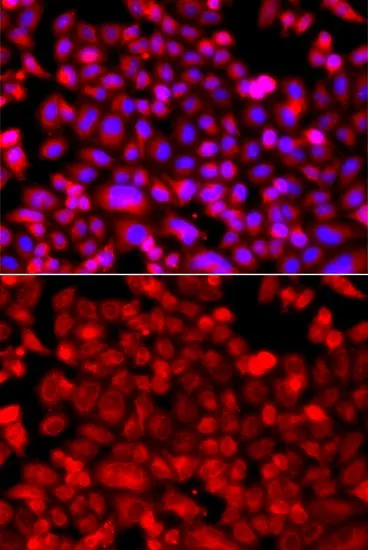
GTX33351
NDUFV1 antibody

Cannot supply to this region.
- SKU:
- GTX33351
- Additional Names:
- NADH:ubiquinone oxidoreductase core subunit V1 , CI-51K , CI51KD , MC1DN4 , UQOR1
- Application:
- WB, IF, ICC
- Physical State:
- Liquid
- Species Reactivity:
- Human
- Purification:
- Affinity Purified
- Storage Conditions:
- -20[o]C Aliquot. Avoid freeze/thaw cycles. Store undiluted., 2-8[o]C Aliquot. Avoid freeze/thaw cycles. Store undiluted., -20[o]C/-70[o]C Aliquot. Avoid freeze/thaw cycles. Store undiluted.
- Supplier:
- Genetex
- Host:
- Rabbit
- Reactivities:
- Human
- Buffer:
- PBS, 50% Glycerol, 0.02% Sodium azide.
- Immunogen:
- Recombinant fusion protein containing a sequence corresponding to amino acids 1-250 of human NDUFV1 (NP_009034.2).
- Uniprot:
- P49821
- Synonyms:
- CI-51K;CI51KD;complex I 51 kda subunit;complex I 51kDa subunit;Complex I-51kD;complex I, mitochondrial respiratory chain;MC1DN4;mitochondrial NADH dehydrogenase ubiquinone flavoprotein 1;mitochondrial NADH:ubiquinone oxidoreductase 51 kda subunit;NADH dehydrogenase (ubiquinone) flavoprotein 1, 51kDa;NADH dehydrogenase [ubiquinone] flavoprotein 1, mitochondrial;NADH dehydrogenase flavoprotein 1;NADH-ubiquinone oxidoreductase 51 kDa subunit;UQOR1
- Extra Details:
- The mitochondrial respiratory chain provides energy to cells via oxidative phosphorylation and consists of four membrane-bound electron-transporting protein complexes (I-IV) and an ATP synthase (complex V). This gene encodes a 51 kDa subunit of the NADH:ubiquinone oxidoreductase complex I; a large complex with at least 45 nuclear and mitochondrial encoded subunits that liberates electrons from NADH and channels them to ubiquinone. This subunit carries the NADH-binding site as well as flavin mononucleotide (FMN)- and Fe-S-biding sites. Defects in complex I are a common cause of mitochondrial dysfunction; a syndrome that occurs in approximately 1 in 10,000 live births. Mitochondrial complex I deficiency is linked to myopathies, encephalomyopathies, and neurodegenerative disorders such as Parkinson's disease and Leigh syndrome. Alternative splicing results in multiple transcript variants encoding distinct isoforms.[provided by RefSeq, Oct 2009]
- Shipping Conditions:
- Blue Ice