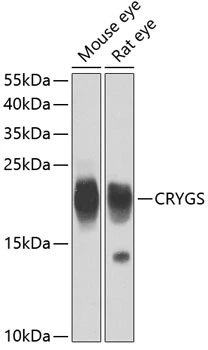
GTX32540
Beta crystallin S antibody

Cannot supply to this region.
- SKU:
- GTX32540
- Additional Names:
- crystallin gamma S , CRYG8 , CTRCT20
- Application:
- WB
- Physical State:
- Liquid
- Species Reactivity:
- Human, Mouse
- Purification:
- Affinity Purified
- Storage Conditions:
- -20[o]C Aliquot. Avoid freeze/thaw cycles. Store undiluted., 2-8[o]C Aliquot. Avoid freeze/thaw cycles. Store undiluted., -20[o]C/-70[o]C Aliquot. Avoid freeze/thaw cycles. Store undiluted.
- Supplier:
- Genetex
- Host:
- Rabbit
- Reactivities:
- Mouse, Rat
- Buffer:
- PBS, 50% Glycerol, 0.02% Sodium azide.
- Immunogen:
- Recombinant fusion protein containing a sequence corresponding to amino acids 1-178 of human CRYGS (NP_060011.1).
- Uniprot:
- P22914
- Synonyms:
- beta-crystallin S;CRYG8;crystallin, gamma 8;CTRCT20;gamma-crystallin S;Gamma-S-crystallin
- Extra Details:
- Crystallins are separated into two classes: taxon-specific, or enzyme, and ubiquitous. The latter class constitutes the major proteins of vertebrate eye lens and maintains the transparency and refractive index of the lens. Since lens central fiber cells lose their nuclei during development, these crystallins are made and then retained throughout life, making them extremely stable proteins. Mammalian lens crystallins are divided into alpha, beta, and gamma families; beta and gamma crystallins are also considered as a superfamily. Alpha and beta families are further divided into acidic and basic groups. Seven protein regions exist in crystallins: four homologous motifs, a connecting peptide, and N- and C-terminal extensions. Gamma-crystallins are a homogeneous group of highly symmetrical, monomeric proteins typically lacking connecting peptides and terminal extensions. They are differentially regulated after early development. This gene encodes a protein initially considered to be a beta-crystallin but the encoded protein is monomeric and has greater sequence similarity to other gamma-crystallins. This gene encodes the most significant gamma-crystallin in adult eye lens tissue. Whether due to aging or mutations in specific genes, gamma-crystallins have been involved in cataract formation. [provided by RefSeq, Jul 2008]
- Shipping Conditions:
- Blue Ice