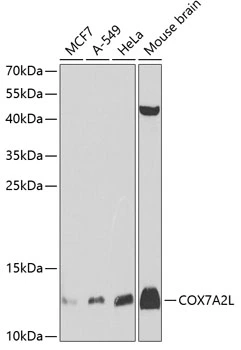
GTX32535
COX7A2L antibody

Cannot supply to this region.
- SKU:
- GTX32535
- Additional Names:
- cytochrome c oxidase subunit 7A2 like , COX7AR , COX7RP , EB1 , SIG81
- Application:
- WB
- Physical State:
- Liquid
- Species Reactivity:
- Human
- Purification:
- Affinity Purified
- Storage Conditions:
- -20[o]C Aliquot. Avoid freeze/thaw cycles. Store undiluted., 2-8[o]C Aliquot. Avoid freeze/thaw cycles. Store undiluted., -20[o]C/-70[o]C Aliquot. Avoid freeze/thaw cycles. Store undiluted.
- Supplier:
- Genetex
- Host:
- Rabbit
- Reactivities:
- Human, Mouse
- Buffer:
- PBS, 50% Glycerol, 0.02% Sodium azide.
- Immunogen:
- Recombinant fusion protein containing a sequence corresponding to amino acids 1-114 of human COX7A2L (NP_004709.2).
- Uniprot:
- O14548
- Synonyms:
- COX7a-related protein;COX7AR;COX7RP;cytochrome c oxidase subunit 7A-related protein, mitochondrial;cytochrome c oxidase subunit VII-related protein;cytochrome c oxidase subunit VIIa polypeptide 2 like;cytochrome c oxidase subunit VIIa-related protein;EB1;estrogen receptor binding CpG island;SCAF1;SCAFI;SIG81
- Extra Details:
- Cytochrome c oxidase (COX), the terminal component of the mitochondrial respiratory chain, catalyzes the electron transfer from reduced cytochrome c to oxygen. This component is a heteromeric complex consisting of 3 catalytic subunits encoded by mitochondrial genes and multiple structural subunits encoded by nuclear genes. The mitochondrially-encoded subunits function in electron transfer, and the nuclear-encoded subunits may function in the regulation and assembly of the complex. This nuclear gene encodes a protein similar to polypeptides 1 and 2 of subunit VIIa in the C-terminal region, and also highly similar to the mouse Sig81 protein sequence. This gene is expressed in all tissues, and upregulated in a breast cancer cell line after estrogen treatment. It is possible that this gene represents a regulatory subunit of COX and mediates the higher level of energy production in target cells by estrogen. Several transcript variants, some protein-coding and others non-protein coding, have been found for this gene. [provided by RefSeq, Jan 2016]
- Shipping Conditions:
- Blue Ice