GTX31657
DC-SIGN antibody

Cannot supply to this region.
- SKU:
- GTX31657
- Additional Names:
- CD209 molecule , CDSIGN , CLEC4L , DC-SIGN , DC-SIGN1
- Application:
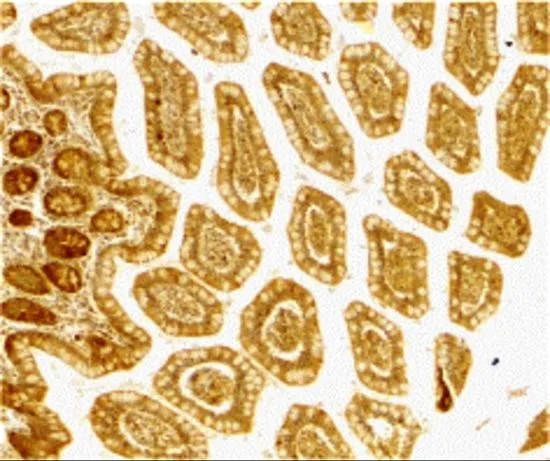
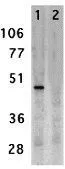
- ELISA, WB, IHC-P
- Concentration:
- 1 mg/ml
- Physical State:
- Liquid
- Species Reactivity:
- Human
- Purification:
- Affinity Purified
- Storage Conditions:
- -20[o]C Aliquot. Avoid freeze/thaw cycles. Store undiluted., 2-8[o]C Aliquot. Avoid freeze/thaw cycles. Store undiluted., -20[o]C/-70[o]C Aliquot. Avoid freeze/thaw cycles. Store undiluted.
- Supplier:
- Genetex
- Host:
- Rabbit
- Reactivities:
- Human
- Buffer:
- PBS, 0.02% Sodium azide.
- Immunogen:
- DC-SIGN antibody was raised against a synthetic peptide corresponding to 17 amino acids near the center of human DC-SIGN.The immunogen is located within amino acids 250 - 300 of DC-SIGN.
- Uniprot:
- Q9NNX6
- Synonyms:
- C-type lectin domain family 4 member L;CD209 antigen;CDSIGN;CLEC4L;DC-SIGN;DC-SIGN1;dendritic cell-specific ICAM-3-grabbing non-integrin 1;dendritic cell-specific intercellular adhesion molecule-3-grabbing non-integrin;dendritic cell-specific intracellular adhesion molecules (ICAM)-3 grabbing non-integrin;hDC-SIGN;HIV gpl20-binding protein
- Extra Details:
- This gene encodes a transmembrane receptor and is often referred to as DC-SIGN because of its expression on the surface of dendritic cells and macrophages. The encoded protein is involved in the innate immune system and recognizes numerous evolutionarily divergent pathogens ranging from parasites to viruses with a large impact on public health. The protein is organized into three distinct domains: an N-terminal transmembrane domain, a tandem-repeat neck domain and C-type lectin carbohydrate recognition domain. The extracellular region consisting of the C-type lectin and neck domains has a dual function as a pathogen recognition receptor and a cell adhesion receptor by binding carbohydrate ligands on the surface of microbes and endogenous cells. The neck region is important for homo-oligomerization which allows the receptor to bind multivalent ligands with high avidity. Variations in the number of 23 amino acid repeats in the neck domain of this protein are rare but have a significant i
- Shipping Conditions:
- Blue Ice