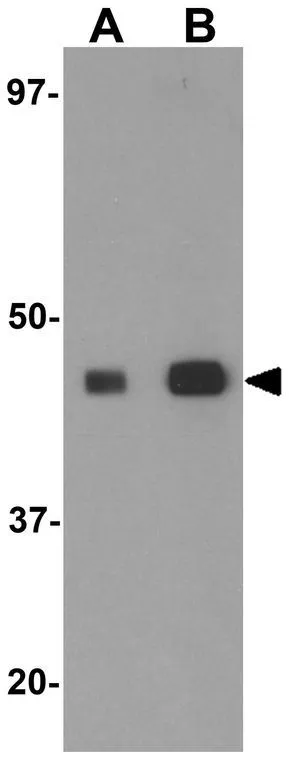
GTX31417
IDH1 antibody

Cannot supply to this region.
- SKU:
- GTX31417
- Additional Names:
- isocitrate dehydrogenase (NADP(+)) 1, cytosolic , HEL-216 , HEL-S-26 , IDCD , IDH , IDP , IDPC , PICD
- Application:
- ELISA, WB
- Concentration:
- 1 mg/ml
- Physical State:
- Liquid
- Species Reactivity:
- Human
- Purification:
- Affinity Purified
- Storage Conditions:
- -20[o]C Aliquot. Avoid freeze/thaw cycles. Store undiluted., 2-8[o]C Aliquot. Avoid freeze/thaw cycles. Store undiluted., -20[o]C/-70[o]C Aliquot. Avoid freeze/thaw cycles. Store undiluted.
- Supplier:
- Genetex
- Host:
- Rabbit
- Reactivities:
- Human, Mouse, Rat
- Buffer:
- PBS, 0.02% Sodium azide.
- Immunogen:
- IDH1 antibody was raised against a 13 amino acid synthetic peptide near the carboxy terminus of human IDH1.The immunogen is located within the last 50 amino acids of IDH1.
- Uniprot:
- O75874
- Synonyms:
- Cytosolic NADP-isocitrate dehydrogenase;epididymis luminal protein 216;epididymis secretory protein Li 26;epididymis secretory sperm binding protein;HEL-216;HEL-S-26;IDCD;IDH;IDP;IDPC;isocitrate dehydrogenase (NADP(+)) 1, cytosolic;isocitrate dehydrogenase [NADP] cytoplasmic;isocitrate dehydrogenase 1 (NADP+), soluble;NADP-dependent isocitrate dehydrogenase, cytosolic;NADP-dependent isocitrate dehydrogenase, peroxisomal;NADP(+)-specific ICDH;oxalosuccinate decarboxylase;PICD
- Extra Details:
- Isocitrate dehydrogenases catalyze the oxidative decarboxylation of isocitrate to 2-oxoglutarate. These enzymes belong to two distinct subclasses, one of which utilizes NAD(+) as the electron acceptor and the other NADP(+). Five isocitrate dehydrogenases have been reported: three NAD(+)-dependent isocitrate dehydrogenases, which localize to the mitochondrial matrix, and two NADP(+)-dependent isocitrate dehydrogenases, one of which is mitochondrial and the other predominantly cytosolic. Each NADP(+)-dependent isozyme is a homodimer. The protein encoded by this gene is the NADP(+)-dependent isocitrate dehydrogenase found in the cytoplasm and peroxisomes. It contains the PTS-1 peroxisomal targeting signal sequence. The presence of this enzyme in peroxisomes suggests roles in the regeneration of NADPH for intraperoxisomal reductions, such as the conversion of 2, 4-dienoyl-CoAs to 3-enoyl-CoAs, as well as in peroxisomal reactions that consume 2-oxoglutarate, namely the alpha-hydroxylation of phytanic acid. The cytoplasmic enzyme serves a significant role in cytoplasmic NADPH production. Alternatively spliced transcript variants encoding the same protein have been found for this gene. [provided by RefSeq, Sep 2013]
- Shipping Conditions:
- Blue Ice