

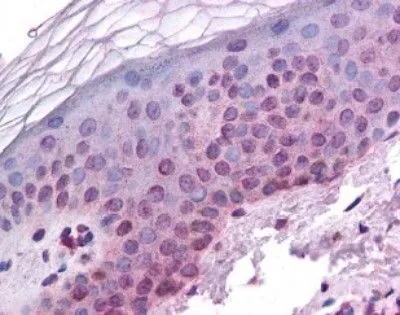
GTX30109
HIF1 beta antibody

Cannot supply to this region.
- SKU:
- GTX30109
- Additional Names:
- aryl hydrocarbon receptor nuclear translocator , HIF-1-beta , HIF-1beta , HIF1-beta , HIF1B , HIF1BETA , TANGO , bHLHe2
- Application:
- ChIP, WB, IHC-P, IF, ICC, IP
- Physical State:
- Liquid
- Species Reactivity:
- Human
- Purification:
- Unpurified
- Storage Conditions:
- -20[o]C Aliquot. Avoid freeze/thaw cycles. Store undiluted., 2-8[o]C Aliquot. Avoid freeze/thaw cycles. Store undiluted., -20[o]C/-70[o]C Aliquot. Avoid freeze/thaw cycles. Store undiluted.
- Supplier:
- Genetex
- Host:
- Rabbit
- Reactivities:
- Bovine, Human, Mouse, Rat, Ovine
- Buffer:
- Serum, 0.02% Sodium azide.
- Immunogen:
- Fusion protein to human HIF-1 beta containing amino acids 496-789. [UniProt# P27540]
- Uniprot:
- P27540
- Synonyms:
- aryl hydrocarbon receptor nuclear translocator;bHLHe2;class E basic helix-loop-helix protein 2;dioxin receptor, nuclear translocator;HIF-1-beta;HIF-1beta;HIF1-beta;HIF1B;HIF1BETA;Hypoxia-inducible factor 1-beta;hypoxia-inducible factor 1, beta subunit;TANGO
- Extra Details:
- The aryl hydrocarbon (Ah) receptor is involved in the induction of several enzymes that participate in xenobiotic metabolism. The ligand-free, cytosolic form of the Ah receptor is complexed to heat shock protein 90. Binding of ligand, which includes dioxin and polycyclic aromatic hydrocarbons, results in translocation of the ligand-binding subunit only to the nucleus. Induction of enzymes involved in xenobiotic metabolism occurs through binding of the ligand-bound Ah receptor to xenobiotic responsive elements in the promoters of genes for these enzymes. This gene encodes a protein that forms a complex with the ligand-bound Ah receptor, and is required for receptor function. The encoded protein has also been identified as the beta subunit of a heterodimeric transcription factor, hypoxia-inducible factor 1 (HIF1). A t(1;12)(q21;p13) translocation, which results in a TEL-ARNT fusion protein, is associated with acute myeloblastic leukemia. Three alternatively spliced variants encoding different isoforms have been described for this gene. [provided by RefSeq]
- Shipping Conditions:
- Blue Ice