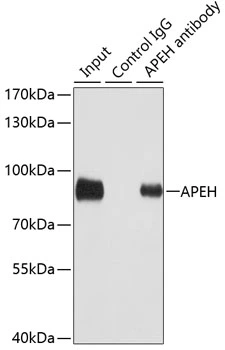
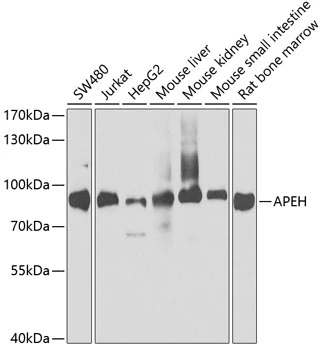
GTX30054
APEH antibody

Cannot supply to this region.
- SKU:
- GTX30054
- Additional Names:
- acylaminoacyl-peptide hydrolase , AARE , ACPH , APH , D3F15S2 , D3S48E , DNF15S2 , OPH
- Application:
- WB, IP
- Physical State:
- Liquid
- Species Reactivity:
- Human
- Purification:
- Affinity Purified
- Storage Conditions:
- -20[o]C Aliquot. Avoid freeze/thaw cycles. Store undiluted., 2-8[o]C Aliquot. Avoid freeze/thaw cycles. Store undiluted., -20[o]C/-70[o]C Aliquot. Avoid freeze/thaw cycles. Store undiluted.
- Supplier:
- Genetex
- Host:
- Rabbit
- Reactivities:
- Human, Mouse, Rat
- Buffer:
- PBS, 50% Glycerol, 0.02% Sodium azide.
- Immunogen:
- Recombinant fusion protein containing a sequence corresponding to amino acids 1-260 of human APEH (NP_001631.3).
- Uniprot:
- P13798
- Synonyms:
- AARE;ACPH;acyl-peptide hydrolase;acylamino-acid-releasing enzyme;acylaminoacyl-peptidase;APH;D3F15S2;D3S48E;DNF15S2;N-acylaminoacyl-peptide hydrolase;OPH;oxidized protein hydrolase
- Extra Details:
- This gene encodes the enzyme acylpeptide hydrolase, which catalyzes the hydrolysis of the terminal acetylated amino acid preferentially from small acetylated peptides. The acetyl amino acid formed by this hydrolase is further processed to acetate and a free amino acid by an aminoacylase. This gene is located within the same region of chromosome 3 (3p21) as the aminoacylase gene, and deletions at this locus are also associated with a decrease in aminoacylase activity. The acylpeptide hydrolase is a homotetrameric protein of 300 kDa with each subunit consisting of 732 amino acid residues. It can play an important role in destroying oxidatively damaged proteins in living cells. Deletions of this gene locus are found in various types of carcinomas, including small cell lung carcinoma and renal cell carcinoma. [provided by RefSeq, Jul 2008]
- Shipping Conditions:
- Blue Ice