GTX28448
Osteopontin antibody

Cannot supply to this region.
- SKU:
- GTX28448
- Additional Names:
- secreted phosphoprotein 1 , BNSP , BSPI , ETA-1 , OPN
- Application:
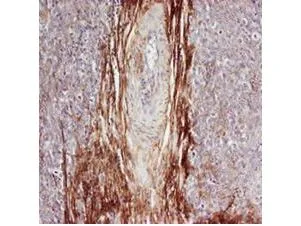
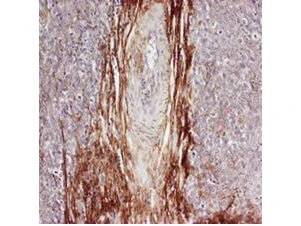
- ELISA, IHC, WB, IHC-P, IHC-Fr, IF, ICC, IP
- Concentration:
- 95 mg/ml
- Physical State:
- Liquid
- Species Reactivity:
- Human
- Storage Conditions:
- -20[o]C Aliquot. Avoid freeze/thaw cycles. Store undiluted., 2-8[o]C Aliquot. Avoid freeze/thaw cycles. Store undiluted., -20[o]C/-70[o]C Aliquot. Avoid freeze/thaw cycles. Store undiluted.
- Supplier:
- Genetex
- Host:
- Rabbit
- Reactivities:
- Human, Mouse, Rat
- Buffer:
- 20mM Potassium Phosphate, 150mM NaCl, 0.01% Sodium azide.
- Immunogen:
- Synthetic peptide from the human osteopontin protein, conjugated to KLH using maleimide, also available as GTX29078.
- Uniprot:
- P10451
- Synonyms:
- BNSP;Bone sialoprotein 1;BSPI;early T-lymphocyte activation 1;ETA-1;nephropontin;OPN;osteopontin;osteopontin/immunoglobulin alpha 1 heavy chain constant region fusion protein;Secreted phosphoprotein 1;secreted phosphoprotein 1 (osteopontin, bone sialoprotein I, early T-lymphocyte activation 1);secreted phosphoprotein 1 variant 6;SPP1/CALPHA1 fusion;urinary stone protein;uropontin
- Extra Details:
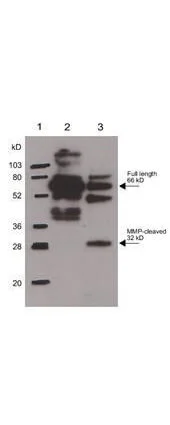
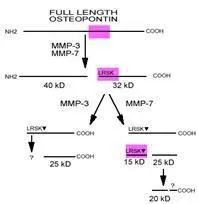
- Osteopontin (OPN) is an arginine-glycine-aspartic acid (RGD)-containing glycoprotein that interacts with integrins and CD44 as major receptors (ref 1). OPN is multifunctional, with activities in cell migration, cell survival, inhibition of calcification, regulation of immune cell function, and control of tumor cell phenotype (ref 1-4). Targeting of the gene encoding OPN, spp1 , has revealed that while OPN is not necessary for normal embryonic development, fertility, and health under pathogen-free conditions (ref 5, 6), loss of the protein has significant consequences in several models of injury/disease as diverse as renal injury, viral and bacterial infection, bone remodeling, and tumor growth (ref 7-12). The fact that no other proteins seem to share a redundant activity with OPN under these conditions suggests that OPN has a unique functional role during tissue injury and stress. Interestingly, several members of the matrix metalloproteinase (MMP) family are also induced during injury/disease processes in patterns overlapping that of OPN (ref 13). OPN has recently been shown to be a novel substrate for two MMPs, MMP-3 (stromelysin-1) and MMP-7 (matrilysin) (ref 14). There are three cleavage sites for MMP-3 in human OPN, two of which are also cleaved by MMP-7 (see cleavage diagram). Biological assays demonstrate that the MMP-cleaved OPN has increased activity in promoting both cell adhesion and migration compared with full-length OPN. In addition, using inhibitory reagents, it was shown that the same receptors that interact with OPN also mediate interaction of MMP-cleaved OPN with tumor cells, suggesting that active forms of OPN at sites of tissue injury may be regulated by the activity of proteases including MMPs and that the differences in activity of modified OPN may be explained by differences in binding affinity of integrins or distinct downstream signaling events (ref 14).
- Shipping Conditions:
- Blue Ice