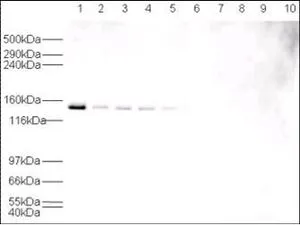
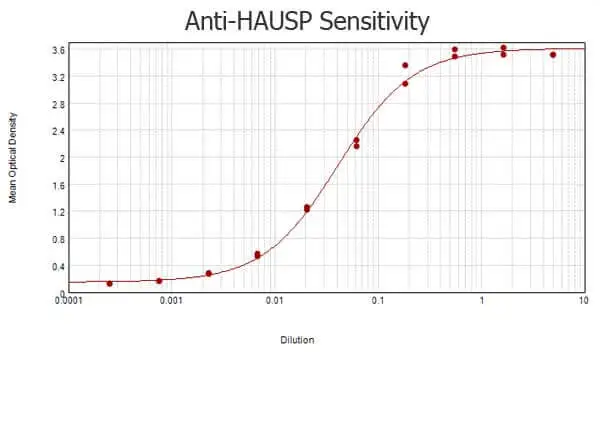
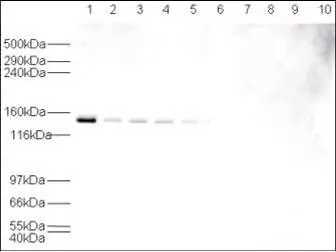
GTX24080
USP7 antibody

Cannot supply to this region.
- SKU:
- GTX24080
- Additional Names:
- ubiquitin specific peptidase 7 , HAUSP , TEF1
- Application:
- ELISA, WB
- Concentration:
- 1.1 mg/ml
- Physical State:
- Liquid
- Species Reactivity:
- Human
- Purification:
- Affinity Purified
- Storage Conditions:
- -20[o]C Aliquot. Avoid freeze/thaw cycles. Store undiluted., 2-8[o]C Aliquot. Avoid freeze/thaw cycles. Store undiluted., -20[o]C/-70[o]C Aliquot. Avoid freeze/thaw cycles. Store undiluted.
- Supplier:
- Genetex
- Host:
- Rabbit
- Reactivities:
- Human, Mouse
- Buffer:
- 20mM Potassium Phosphate, 150mM NaCl, 0.01% Sodium azide.
- Immunogen:
- Synthetic peptide corresponding to amino acids near the amino terminus of human HAUSP protein.
- Uniprot:
- Q93009
- Synonyms:
- deubiquitinating enzyme 7;HAFOUS;HAUSP;Herpes virus-associated ubiquitin-specific protease;Herpesvirus-associated ubiquitin-specific protease;TEF1;ubiquitin carboxyl-terminal hydrolase 7;ubiquitin specific peptidase 7 (herpes virus-associated);ubiquitin specific protease 7 (herpes virus-associated);ubiquitin thioesterase 7;ubiquitin-specific-processing protease 7
- Extra Details:
- HAUSP is a novel p53 interacting protein identified by mass spectrometry of affinity-purified p53 associated factors by Li et al. HAUSP strongly stabilizes p53 even in the presence of excess MDM2, and also induces p53-dependent cell growth repression and apoptosis. HAUSP has an intrinsic enzymatic activity that specifically de-ubiquitinates p53 both in vivo and in vitro. Expression of a catalytically inactive point mutation of HAUSP in cells increased the levels of p53 ubiquitination and also destabilized p53. Li et al concluded that their findings revealed an important mechanism by which p53 can be stabilized by direct de-ubiquitination and also implied that HAUSP may function as a tumor suppressor in vivo through the stabilization of p53.
- Shipping Conditions:
- Blue Ice