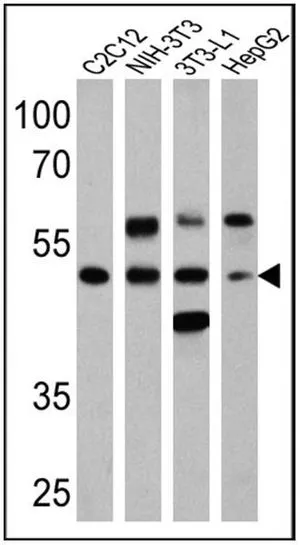
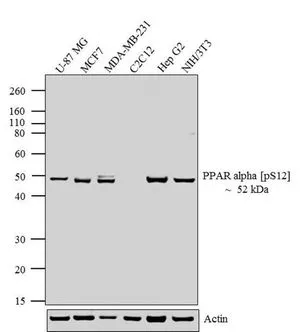
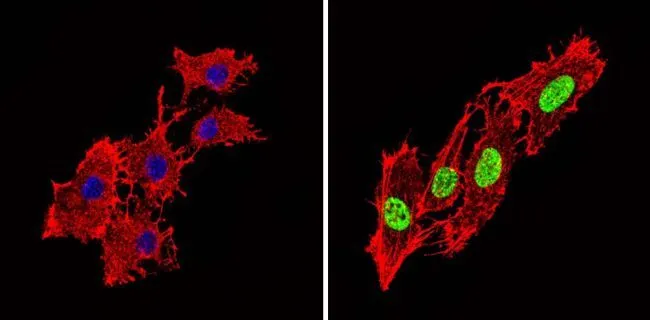
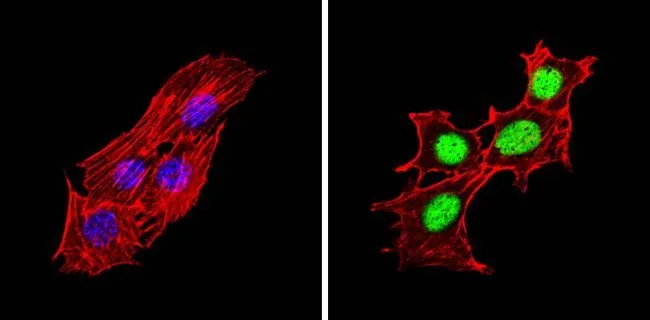
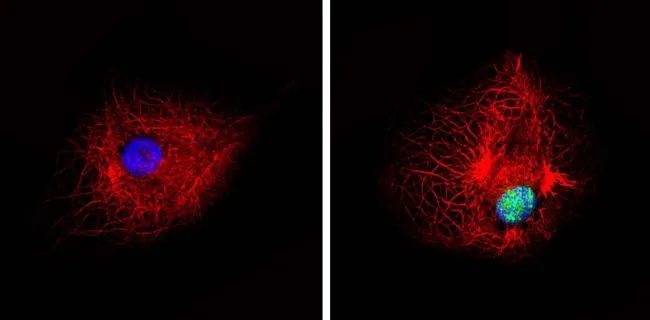
GTX23484
PPAR alpha (phospho Ser12) antibody

Cannot supply to this region.
- SKU:
- GTX23484
- Additional Names:
- peroxisome proliferator activated receptor alpha , 4933429D07Rik , AW742785 , Nr1c1 , PPAR-alpha , PPARalpha , Ppar
- Application:
- Flow Cytometry, WB, IF, ICC
- Concentration:
- 1 mg/ml
- Physical State:
- Liquid
- Species Reactivity:
- Human, Mouse
- Purification:
- Affinity Purified
- Storage Conditions:
- -20[o]C Aliquot. Avoid freeze/thaw cycles. Store undiluted., 2-8[o]C Aliquot. Avoid freeze/thaw cycles. Store undiluted., -20[o]C/-70[o]C Aliquot. Avoid freeze/thaw cycles. Store undiluted.
- Supplier:
- Genetex
- Host:
- Rabbit
- Reactivities:
- Human, Mouse
- Buffer:
- PBS, 0.1% BSA, 0.05% Sodium azide.
- Immunogen:
- Synthetic phosphopeptide corresponding to residues I(8) C P L (pS) P L E A D D L(19) of mouse PPAR alpha.
- Uniprot:
- P23204
- Synonyms:
- 4933429D07Rik;AW742785;Nr1;Nr1c1;nuclear receptor subfamily 1 group C member 1;P;peroxisome proliferator-activated receptor alpha;PP;Ppar;PPAR-alpha;PPARalpha
- Extra Details:
- Peroxisome proliferators are non-genotoxic carcinogens which are purported to exert their effect on cells through their interaction with members of the nuclear hormone receptor family, termed peroxisome proliferator activated receptors (PPARs). Nuclear hormone receptors are ligand-dependent intracellular proteins that stimulate transcription of specific genes by binding to specific DNA sequences following activation by the appropriate ligand. Studies indicate that PPARs are activated by peroxisome proliferators such as clofibric acid, nafenopin, and WY-14,643, as well as by some fatty acids. It has also been shown that PPARs can induce transcription of acyl coenzyme A oxidase & cytochrome P450 A6 (CYP450 A6) through interaction with specific response elements. PPAR alpha is activated by free fatty acids including linoleic, arachidonic, and oleic acids. Induction of peroxisomes by this mechanism leads to a reduction in blood triglyceride levels. PPAR alpha is expressed mainly in skeletal muscle, heart, liver, and kidney and is thought to regulate many genes involved in the beta-oxidation of fatty acids. Activation of rat liver PPAR alpha has been shown to suppress hepatocyte apoptosis. PPAR alpha, like several other nuclear hormone receptors, heterodimerizes with retinoic X receptor (RXR) alpha to form a transcriptionally competent complex. The corresponding gene for the phospho-PPAR alpha is NR1C1.
- Shipping Conditions:
- Blue Ice