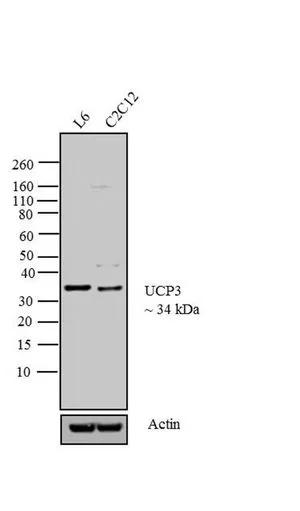
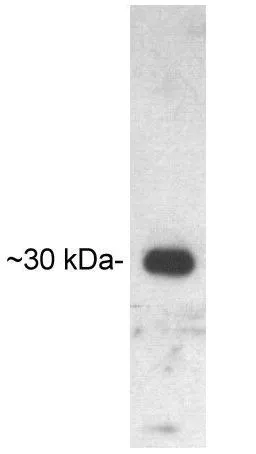
GTX23477
UCP3 antibody

Cannot supply to this region.
- SKU:
- GTX23477
- Additional Names:
- uncoupling protein 3 (mitochondrial, proton carrier) , AI645527 , Slc25a9 , UCP-3
- Application:
- WB
- Concentration:
- 1 mg/ml
- Physical State:
- Liquid
- Species Reactivity:
- Mouse
- Purification:
- Affinity Purified
- Storage Conditions:
- -20[o]C Aliquot. Avoid freeze/thaw cycles. Store undiluted., 2-8[o]C Aliquot. Avoid freeze/thaw cycles. Store undiluted., -20[o]C/-70[o]C Aliquot. Avoid freeze/thaw cycles. Store undiluted.
- Supplier:
- Genetex
- Host:
- Rabbit
- Reactivities:
- Canine, Human, Mouse, Rat
- Buffer:
- PBS, 0.1% BSA, 0.05% Sodium azide.
- Immunogen:
- Synthetic peptide corresponding to residues C R(295) A L M K V Q V L R E S P F(308) of mouse and rat UCP-3.
- Uniprot:
- P56501
- Synonyms:
- AI645527;mitochondrial uncoupling protein 3;Slc2;Slc25a9;solute carrier family 25 member 9;UCP-;UCP-3
- Extra Details:
- The uncoupling proteins (UCPs) are found in the inner mitochondrial membranes and belong to a family of mitochondrial anion transport proteins that include the phosphate and oxologutarate carriers and the ADP/ATP translocator. Three UCP subtypes have been identified and cloned. UCP-1 is abundantly expressed in brown adipose tissue of mammals. UCP-1 allows proton re-entry into the mitochondrial matrix without involving the F0-F1 ATPase which produces heat instead of ATP. It is thought that UCP-2 and 3 also dissipate the mitochondrial proton gradient produced by the respiratory chain in cells and tissues within which they are expressed. Studies have shown UCP-2 to be expressed by a variety of tissues. UCP-3 is expressed predominantly in brown adipose tissue, skeletal muscle, at lower levels in heart and smooth muscle, and is absent in liver and kidney.
- Shipping Conditions:
- Blue Ice