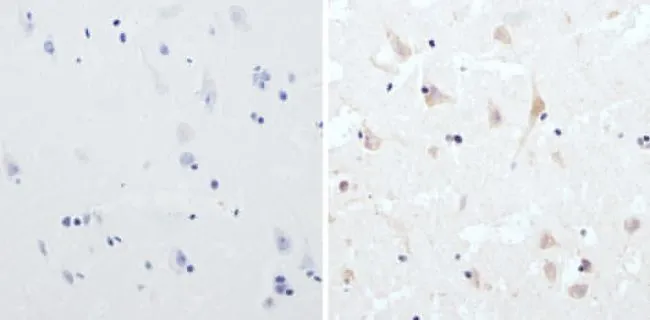
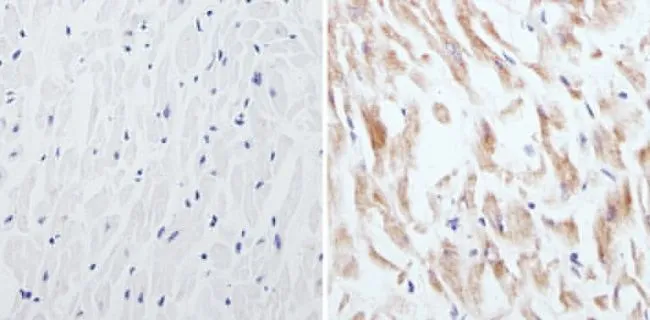
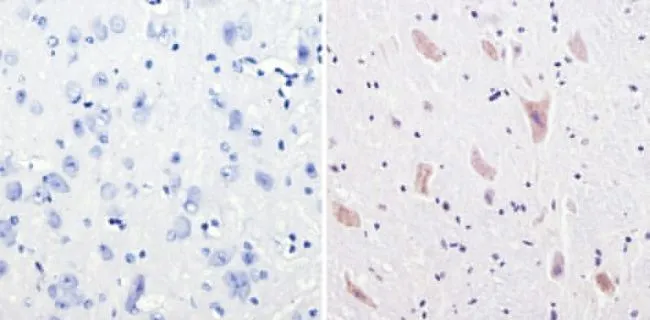
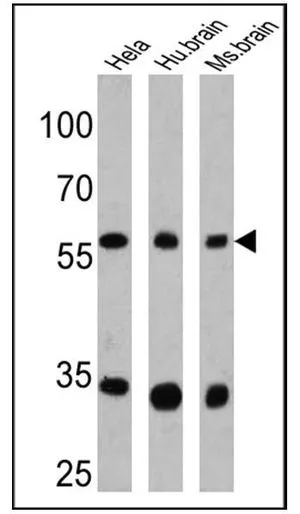
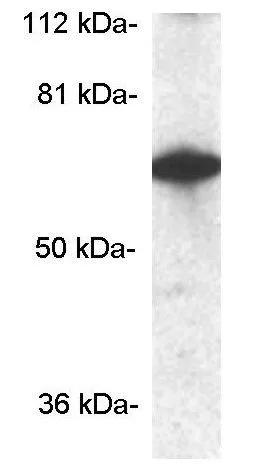
GTX23465
CPEB1 antibody

Cannot supply to this region.
- SKU:
- GTX23465
- Additional Names:
- cytoplasmic polyadenylation element binding protein 1 , AU024112 , Cpe-bp1 , Cpeb , mCPEB , mCpeb-1
- Application:
- WB, IHC-P, IF, ICC, IP
- Concentration:
- 1 mg/ml
- Physical State:
- Liquid
- Species Reactivity:
- Human
- Purification:
- Affinity Purified
- Storage Conditions:
- -20[o]C Aliquot. Avoid freeze/thaw cycles. Store undiluted., 2-8[o]C Aliquot. Avoid freeze/thaw cycles. Store undiluted., -20[o]C/-70[o]C Aliquot. Avoid freeze/thaw cycles. Store undiluted.
- Supplier:
- Genetex
- Host:
- Rabbit
- Reactivities:
- Human, Mouse, Rat
- Buffer:
- PBS, 0.1% BSA, 0.05% Sodium azide.
- Immunogen:
- Synthetic peptide corresponding to residues C H(545) S M E G L R H H S P L M R N Q K N(562) of human CPEB.
- Uniprot:
- P70166
- Synonyms:
- AU024112;CPE-binding protein 1;Cpe-bp1;Cpeb;cytoplasmic polyadenylation element-binding protein 1;mCPEB;mCpeb-1
- Extra Details:
- The regulated translation of messenger RNA is essential for cell-cycle progression, establishment of the body plan during early development, and modulation of key activities in the central nervous system. Cytoplasmic polyadenylation, which is one mechanism of controlling translation, is driven by CPEB (cytoplasmic polyadenylation element binding protein), a highly conserved, sequence-specific RNA-binding protein that binds to the cytoplasmic polyadenylation element, and modulates translational repression and mRNA localization. In both vertebrates and invertebrates, the expression of several maternal mRNAs is regulated by cytoplasmic polyadenylation. In Xenopus oocytes, where most of the biochemical details of this process have been examined, polyadenylation is controlled by CPEB. Early metazoan development is programmed by maternal mRNAs inherited by the egg at the time of fertilization. These mRNAs are not translated en masse at any one time or at any one place, but instead their expression is regulated both temporally and spatially. Mammalian neurons, particularly in the synapto-dendritic compartment, also contain localized mRNAs such as that encoding alpha-CaMKII. Here, synaptic activation drives local translation, an event that is involved in synaptic plasticity and possibly long-term memory storage. Synaptic translation of alpha-CaMKII mRNA also appears to be controlled by CPEB, which is enriched in the postsynaptic density. Therefore, CPEB-controlled local translation may influence such seemingly disparate processes as the cell cycle and synaptic plasticity.
- Shipping Conditions:
- Blue Ice