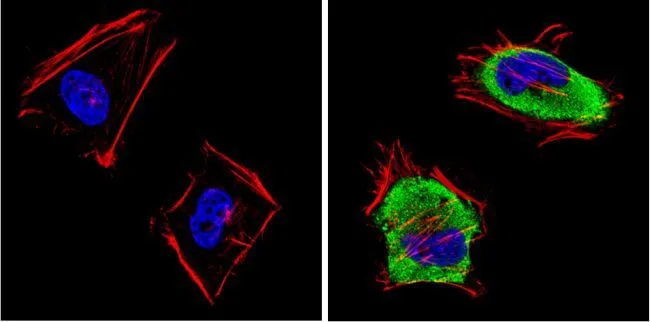
GTX23437
SAP97 antibody

Cannot supply to this region.
- SKU:
- GTX23437
- Additional Names:
- discs large MAGUK scaffold protein 1 , B130052P05Rik , Dlgh1 , E-dlg/SAP97 , SAP-97 , SAP97 , mKIAA4187
- Application:
- IHC, WB, IHC-Fr, IF, ICC, IP
- Physical State:
- Liquid
- Species Reactivity:
- Human, Rat
- Purification:
- Ammonium Sulfate Precipitated
- Storage Conditions:
- -20[o]C Aliquot. Avoid freeze/thaw cycles. Store undiluted., 2-8[o]C Aliquot. Avoid freeze/thaw cycles. Store undiluted., -20[o]C/-70[o]C Aliquot. Avoid freeze/thaw cycles. Store undiluted.
- Supplier:
- Genetex
- Host:
- Rabbit
- Reactivities:
- Human, Mouse, Rat
- Buffer:
- PBS, 0.05% Sodium azide.
- Immunogen:
- Synthetic peptide corresponding to residues V(115) L P S E R I S P Q V P N E V L G P E(133) of rat SAP97.
- Uniprot:
- Q811D0
- Synonyms:
- B130052P05Rik;discs, large homolog 1;disks large homolog 1;Dlgh;Dlgh1;E-dlg/SAP97;embryo-dlg/synapse-associated protein 97;mKIAA4187;SA;SAP-97;SAP97;Synapse-associated protein 97
- Extra Details:
- Synapse-Associated Protein 97 (SAP97/human homologue of Drosophila discs-large tumor supressor or HDLG) is one of a family of plasma membrane-associated proteins found in synaptic junctions. This is a novel, presynaptic membrane protein homologous to SAP90 and the Drosophila discs-large tumor supressor protein. SAP97 has three ~90 amino acid repeats called PDZ domains, a single interior SH3 domain, and a carboxyl-terminal guanylate kinase homology (GuK) domain that is enzymatically inactive. It is hypothesized that PDZ-domain interactions play a role in receptor and channel clustering which contributes to neuronal plasticity. SAP97 is believed to participate in the clustering of certain proteins, including N-methyl-D-aspartate (NMDA) receptors and Shaker-type potassium channels at the synaptic membrane. There are two principal modes of interaction between SAP97 and other proteins. NMDA receptors and Shaker-type potassium channels both share C-terminal sequence homology consisting of a threonine/serine-X-valine-COOH (T/SXV) motif. Other neuronal proteins that share this motif (beta 1 adrenergic receptor, some serotonin receptors, some sodium channel subunits, and additional potassium channel subunits) may interact with SAP97 by binding to its PDZ domains. Neuronal nitric oxide synthase (nNOS), which lacks the T/SXV motif but which has its own PDZ domain, has been shown to associate with SAP97 in vitro through a pseudo-homotypic PDZ-PDZ interaction.
- Shipping Conditions:
- Blue Ice