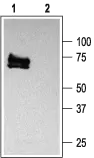
GTX16637
Kv1.3 antibody

Cannot supply to this region.
- SKU:
- GTX16637
- Additional Names:
- potassium voltage-gated channel subfamily A member 3 , HGK5 , HLK3 , HPCN3 , HUKIII , KV1.3 , MK3 , PCN3
- Application:
- IHC, WB, IF, ICC, IP
- Concentration:
- 0.6 mg/ml
- Physical State:
- Liquid
- Species Reactivity:
- Human
- Purification:
- Affinity Purified
- Storage Conditions:
- -20[o]C Aliquot. Avoid freeze/thaw cycles. Store undiluted., 2-8[o]C Aliquot. Avoid freeze/thaw cycles. Store undiluted., -20[o]C/-70[o]C Aliquot. Avoid freeze/thaw cycles. Store undiluted.
- Supplier:
- Genetex
- Host:
- Rabbit
- Reactivities:
- Human, Mouse, Rat
- Buffer:
- PBS, 1% BSA, 5% Sucrose, 0.025% Sodium azide.
- Immunogen:
- GST fusion protein with sequence TLSKSEYMVIEEGGMNHSAFPQTPFKTGNSTATCTTNNNPNSCVNIKKIFTDV, corresponding to amino acid residues 523-575 (Intracellular, C-terminus) of human KV1.3 (Accession : P22001).
- Uniprot:
- P22001
- Synonyms:
- HGK5;HLK3;HPCN3;HUKIII;KV1.3;MK3;PCN3;potassium channel 3;potassium channel, voltage gated shaker related subfamily A, member 3;potassium voltage-gated channel subfamily A member 3;potassium voltage-gated channel, shaker-related subfamily, member 3;type n potassium channel;voltage-gated K(+) channel HuKIII;voltage-gated potassium channel protein Kv1.3;voltage-gated potassium channel subunit Kv1.3
- Extra Details:
- Potassium channels represent the most complex class of voltage-gated ion channels from both functional and structural standpoints. Their diverse functions include regulating neurotransmitter release, heart rate, insulin secretion, neuronal excitability, epithelial electrolyte transport, smooth muscle contraction, and cell volume. Four sequence-related potassium channel genes - shaker, shaw, shab, and shal - have been identified in Drosophila, and each has been shown to have human homolog(s). This gene encodes a member of the potassium channel, voltage-gated, shaker-related subfamily. This member contains six membrane-spanning domains with a shaker-type repeat in the fourth segment. It belongs to the delayed rectifier class, members of which allow nerve cells to efficiently repolarize following an action potential. It plays an essential role in T-cell proliferation and activation. This gene appears to be intronless and it is clustered together with KCNA2 and KCNA10 genes on chromosome 1. [provided by RefSeq, Jul 2008]
- Shipping Conditions:
- Blue Ice