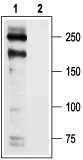
GTX16608
Cav1.2 antibody

Cannot supply to this region.
- SKU:
- GTX16608
- Additional Names:
- calcium voltage-gated channel subunit alpha1 C , CACH2 , CACN2 , CACNL1A1 , CCHL1A1 , CaV1.2 , LQT8 , TS
- Application:
- WB, IF, ICC
- Concentration:
- 0.8 mg/ml
- Physical State:
- Liquid
- Species Reactivity:
- Human
- Purification:
- Affinity Purified
- Storage Conditions:
- -20[o]C Aliquot. Avoid freeze/thaw cycles. Store undiluted., 2-8[o]C Aliquot. Avoid freeze/thaw cycles. Store undiluted., -20[o]C/-70[o]C Aliquot. Avoid freeze/thaw cycles. Store undiluted.
- Supplier:
- Genetex
- Host:
- Rabbit
- Reactivities:
- Human, Mouse, Rat
- Buffer:
- PBS, 1% BSA, 0.05% Sodium azide.
- Immunogen:
- Peptide VNENTRMYIPEENHQ(C), corresponding to amino acid residues 2-15 (Intracellular, N-terminus) of human CaV1.2 (exon 1B) (Accession : Q13936).
- Uniprot:
- Q13936
- Synonyms:
- CACH2;CACN2;CACNL1A1;calcium channel, cardic dihydropyridine-sensitive, alpha-1 subunit;Calcium channel, L type, alpha-1 polypeptide, isoform 1, cardiac muscle;calcium channel, voltage-dependent, L type, alpha 1C subunit;CaV1.2;CCHL1A1;DHPR, alpha-1 subunit;LQT8;TS;TS. LQT8;voltage-dependent L-type Ca2+ channel alpha 1 subunit;voltage-dependent L-type calcium channel subunit alpha-1C;Voltage-gated calcium channel subunit alpha Cav1.2;voltage-gated L-type calcium channel Cav1.2 alpha 1 subunit, splice variant 10*
- Extra Details:
- This gene encodes an alpha-1 subunit of a voltage-dependent calcium channel. Calcium channels mediate the influx of calcium ions into the cell upon membrane polarization. The alpha-1 subunit consists of 24 transmembrane segments and forms the pore through which ions pass into the cell. The calcium channel consists of a complex of alpha-1, alpha-2/delta, beta, and gamma subunits in a 1:1:1:1 ratio. There are multiple isoforms of each of these proteins, either encoded by different genes or the result of alternative splicing of transcripts. The protein encoded by this gene binds to and is inhibited by dihydropyridine. Alternative splicing results in many transcript variants encoding different proteins. Some of the predicted proteins may not produce functional ion channel subunits. [provided by RefSeq, Oct 2012]
- Shipping Conditions:
- Blue Ice