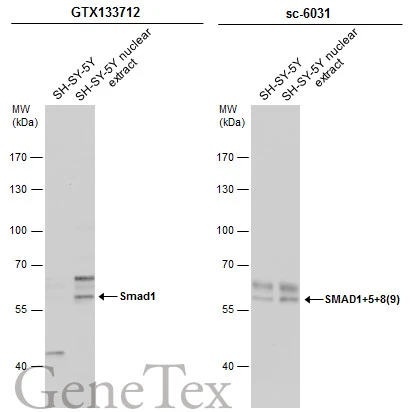
GTX133712
Smad1 antibody

Cannot supply to this region.
- SKU:
- GTX133712
- Additional Names:
- SMAD family member 1 , BSP-1 , BSP1 , JV4-1 , JV41 , MADH1 , MADR1
- Application:
- WB
- Concentration:
- 0.85 mg/ml
- Physical State:
- Liquid
- Species Reactivity:
- Human
- Purification:
- Affinity Purified
- Storage Conditions:
- -20[o]C Aliquot. Avoid freeze/thaw cycles. Store undiluted., 2-8[o]C Aliquot. Avoid freeze/thaw cycles. Store undiluted., -20[o]C/-70[o]C Aliquot. Avoid freeze/thaw cycles. Store undiluted.
- Supplier:
- Genetex
- Host:
- Rabbit
- Reactivities:
- Human
- Buffer:
- PBS, 20% Glycerol, 0.025% ProClin 300.
- Immunogen:
- Carrier-protein conjugated synthetic peptide encompassing a sequence within the N-terminus region of human SMAD1. The exact sequence is proprietary.
- Uniprot:
- Q15797
- Synonyms:
- BSP-1;BSP1;JV4-1;JV41;Mad-related protein 1;MAD, mothers against decapentaplegic homolog 1;MADH1;MADR1;mothers against decapentaplegic homolog 1;mothers against DPP homolog 1;SMAD family member 1;SMAD, mothers against DPP homolog 1;TGF-beta signaling protein 1;transforming growth factor-beta signaling protein 1;Transforming growth factor-beta-signaling protein 1
- Extra Details:
- The protein encoded by this gene belongs to the SMAD, a family of proteins similar to the gene products of the Drosophila gene 'mothers against decapentaplegic' (Mad) and the C. elegans gene Sma. SMAD proteins are signal transducers and transcriptional modulators that mediate multiple signaling pathways. This protein mediates the signals of the bone morphogenetic proteins (BMPs), which are involved in a range of biological activities including cell growth, apoptosis, morphogenesis, development and immune responses. In response to BMP ligands, this protein can be phosphorylated and activated by the BMP receptor kinase. The phosphorylated form of this protein forms a complex with SMAD4, which is important for its function in the transcription regulation. This protein is a target for SMAD-specific E3 ubiquitin ligases, such as SMURF1 and SMURF2, and undergoes ubiquitination and proteasome-mediated degradation. Alternatively spliced transcript variants encoding the same protein have been observed. [provided by RefSeq, Jul 2008]
- Shipping Conditions:
- Blue Ice