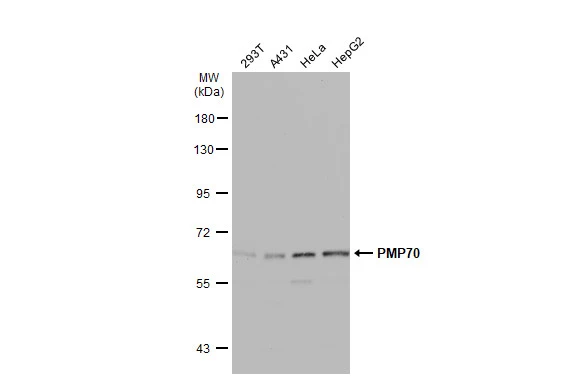
GTX132960
PMP70 antibody

Cannot supply to this region.
- SKU:
- GTX132960
- Additional Names:
- ATP binding cassette subfamily D member 3 , ABC43 , CBAS5 , PMP70 , PXMP1 , ZWS2
- Application:
- WB
- Concentration:
- 1.74 mg/ml
- Physical State:
- Liquid
- Species Reactivity:
- Human
- Purification:
- Affinity Purified
- Storage Conditions:
- -20[o]C Aliquot. Avoid freeze/thaw cycles. Store undiluted., 2-8[o]C Aliquot. Avoid freeze/thaw cycles. Store undiluted., -20[o]C/-70[o]C Aliquot. Avoid freeze/thaw cycles. Store undiluted.
- Supplier:
- Genetex
- Host:
- Rabbit
- Reactivities:
- Human
- Buffer:
- PBS, 20% Glycerol, 0.025% ProClin 300.
- Immunogen:
- Carrier-protein conjugated synthetic peptide encompassing a sequence within the center region of human PMP70. The exact sequence is proprietary.
- Uniprot:
- P28288
- Synonyms:
- 70 kDa peroxisomal membrane protein;ABC43;ATP-binding cassette sub-family D member 3;ATP-binding cassette, sub-family D (ALD), member 3;CBAS5;dJ824O18.1 (ATP-binding cassette, sub-family D (ALD), member 3 (PMP70, PXMP1));peroxisomal membrane protein 1 (70kD, Zellweger syndrome);peroxisomal membrane protein 70 kDa;Peroxisomal membrane protein-1 (70kD);PMP70;PXMP1;ZWS2
- Extra Details:
- The protein encoded by this gene is a member of the superfamily of ATP-binding cassette (ABC) transporters. ABC proteins transport various molecules across extra- and intra-cellular membranes. ABC genes are divided into seven distinct subfamilies (ABC1, MDR/TAP, MRP, ALD, OABP, GCN20, White). This protein is a member of the ALD subfamily, which is involved in peroxisomal import of fatty acids and/or fatty acyl-CoAs in the organelle. All known peroxisomal ABC transporters are half transporters which require a partner half transporter molecule to form a functional homodimeric or heterodimeric transporter. This peroxisomal membrane protein likely plays an important role in peroxisome biogenesis. Mutations have been associated with some forms of Zellweger syndrome, a heterogeneous group of peroxisome assembly disorders. Alternative splicing results in multiple transcript variants encoding distinct isoforms. [provided by RefSeq, Jul 2008]
- Shipping Conditions:
- Blue Ice