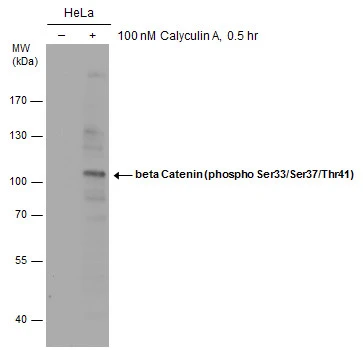
GTX132605
beta Catenin (phospho Ser33/Ser37/Thr41) antibody

Cannot supply to this region.
- SKU:
- GTX132605
- Additional Names:
- catenin beta 1 , CTNNB , EVR7 , MRD19 , armadillo
- Application:
- WB
- Concentration:
- 2.45 mg/ml
- Physical State:
- Liquid
- Species Reactivity:
- Human
- Purification:
- Affinity Purified
- Storage Conditions:
- -20[o]C Aliquot. Avoid freeze/thaw cycles. Store undiluted., 2-8[o]C Aliquot. Avoid freeze/thaw cycles. Store undiluted., -20[o]C/-70[o]C Aliquot. Avoid freeze/thaw cycles. Store undiluted.
- Supplier:
- Genetex
- Host:
- Rabbit
- Reactivities:
- Human
- Buffer:
- PBS, 1% BSA, 20% Glycerol, 0.025% ProClin 300.
- Immunogen:
- Carrier-protein conjugated synthetic peptide surrounding phospho Ser33/Ser37/Thr41 of human beta Catenin. The exact sequence is proprietary.
- Uniprot:
- P35222
- Synonyms:
- armadillo;Beta-catenin;catenin (cadherin-associated protein), beta 1, 88kDa;catenin beta-1;CTNNB;EVR7;MRD19;NEDSDV
- Extra Details:
- Beta-catenin is an adherens junction protein. Adherens junctions (AJs; also called the zonula adherens) are critical for the establishment and maintenance of epithelial layers, such as those lining organ surfaces. AJs mediate adhesion between cells, communicate a signal that neighboring cells are present, and anchor the actin cytoskeleton. In serving these roles, AJs regulate normal cell growth and behavior. At several stages of embryogenesis, wound healing, and tumor cell metastasis, cells form and leave epithelia. This process, which involves the disruption and reestablishment of epithelial cell-cell contacts, may be regulated by the disassembly and assembly of AJs. AJs may also function in the transmission of the 'contact inhibition' signal, which instructs cells to stop dividing once an epithelial sheet is complete.[supplied by OMIM]
- Shipping Conditions:
- Blue Ice