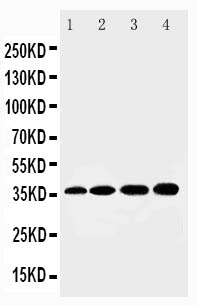
GTX12312
HSD17B1 antibody

Cannot supply to this region.
- SKU:
- GTX12312
- Application:
- WB, IHC-P, IF, ICC
- Concentration:
- 500 ug/ml
- Physical State:
- Liquid
- Species Reactivity:
- Human
- Purification:
- Affinity Purified
- Storage Conditions:
- -20[o]C Aliquot. Avoid freeze/thaw cycles. Store undiluted., 2-8[o]C Aliquot. Avoid freeze/thaw cycles. Store undiluted., -20[o]C/-70[o]C Aliquot. Avoid freeze/thaw cycles. Store undiluted.
- Supplier:
- Genetex
- Host:
- Rabbit
- Reactivities:
- Human, Mouse, Rat
- Buffer:
- 0.1% Na₂HPO₄, 0.45% NaCl, 2.5% BSA, 0.025% Thimerosal, 0.025% Sodium azide.
- Immunogen:
- A synthetic peptide corresponding to a sequence at the N-terminus of human HSD17B1(29-43aa QSFKVYATLRDLKTQ), different from the related rat and mouse sequences by one amino acid.
- Uniprot:
- P14061
- Synonyms:
- 17-beta-HSD;17-beta-HSD 1;17-beta-hydroxysteroid dehydrogenase type 1;20 alpha-hydroxysteroid dehydrogenase;20-alpha-HSD;E2DH;EDH17B2;EDHB17;estradiol 17-beta-dehydrogenase 1;HSD17;placental 17-beta-hydroxysteroid dehydrogenase;SDR28C1;short chain dehydrogenase/reductase family 28C member 1;short chain dehydrogenase/reductase family 28CE, member 1
- Extra Details:
- This gene encodes a member of the 17beta-hydroxysteroid dehydrogenase family of short-chain dehydrogenases/reductases. It has a dual function in estrogen activation and androgen inactivation and plays a major role in establishing the estrogen E2 concentration gradient between serum and peripheral tissues. The encoded protein catalyzes the last step in estrogen activation, using NADPH to convert estrogens E1 and E2 and androgens like 4-androstenedione, to testosterone. It has an N-terminal short-chain dehydrogenase domain with a cofactor binding site, and a narrow, hydrophobic C-terminal domain with a steroid substrate binding site. This gene is expressed primarily in the placenta and ovarian granulosa cells, and to a lesser extent, in the endometrium, adipose tissue, and prostate. Polymorphisms in this gene have been linked to breast and prostate cancer. A pseudogene of this gene has been identified. Alternative splicing results in multiple transcript variants. [provided by RefSeq, Sep 2016]
- Shipping Conditions:
- Blue Ice