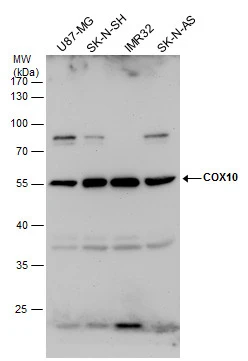
GTX114331
COX10 antibody

Cannot supply to this region.
- SKU:
- GTX114331
- Additional Names:
- cytochrome c oxidase assembly factor heme A:farnesyltransferase COX10
- Application:
- WB
- Concentration:
- 1 mg/ml
- Physical State:
- Liquid
- Species Reactivity:
- Human
- Purification:
- Affinity Purified
- Storage Conditions:
- -20[o]C Aliquot. Avoid freeze/thaw cycles. Store undiluted., 2-8[o]C Aliquot. Avoid freeze/thaw cycles. Store undiluted., -20[o]C/-70[o]C Aliquot. Avoid freeze/thaw cycles. Store undiluted.
- Supplier:
- Genetex
- Host:
- Rabbit
- Reactivities:
- Human
- Buffer:
- PBS, 20% Glycerol, 0.01% Thimerosal.
- Immunogen:
- Recombinant protein encompassing a sequence within the center region of human COX10. The exact sequence is proprietary.
- Uniprot:
- Q12887
- Synonyms:
- COX10 homolog, cytochrome c oxidase assembly protein, heme A: farnesyltransferase;COX10, heme A:farnesyltransferase cytochrome c oxidase assembly factor;cytochrome c oxidase assembly homolog 10;cytochrome c oxidase assembly protein;cytochrome c oxidase subunit X;heme A: farnesyltransferase;heme O synthase;MC4DN3;protoheme IX farnesyltransferase, mitochondrial
- Extra Details:
- Cytochrome c oxidase (COX), the terminal component of the mitochondrial respiratory chain, catalyzes the electron transfer from reduced cytochrome c to oxygen. This component is a heteromeric complex consisting of 3 catalytic subunits encoded by mitochondrial genes and multiple structural subunits encoded by nuclear genes. The mitochondrially-encoded subunits function in electron transfer, and the nuclear-encoded subunits may function in the regulation and assembly of the complex. This nuclear gene encodes heme A:farnesyltransferase, which is not a structural subunit but required for the expression of functional COX and functions in the maturation of the heme A prosthetic group of COX. This protein is predicted to contain 7-9 transmembrane domains localized in the mitochondrial inner membrane. A gene mutation, which results in the substitution of a lysine for an asparagine (N204K), is identified to be responsible for cytochrome c oxidase deficiency. In addition, this gene is disrupted in patients with CMT1A (Charcot-Marie-Tooth type 1A) duplication and with HNPP (hereditary neuropathy with liability to pressure palsies) deletion. [provided by RefSeq]
- Shipping Conditions:
- Blue Ice