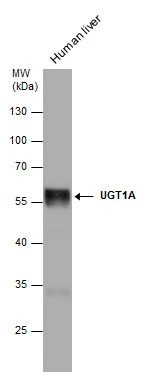
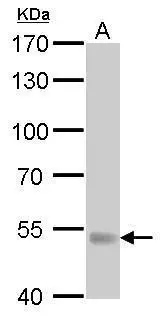
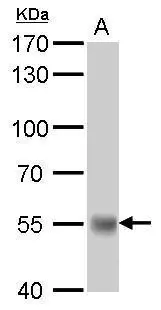
GTX114131
UGT1A antibody

Cannot supply to this region.
- SKU:
- GTX114131
- Additional Names:
- BILIQTL1 antibody , GNT1 antibody , HUG-BR1 antibody , UDPGT antibody , UDPGT 1-1 antibody , UGT1 antibody , UGT1A antibody , UGT1A1 antibody , UDP-glucuronosyltransferase 1A1 antibody , UDP glycosyltransferase 1 family , polypeptide A1 antibody , bilirubin-specific UDPGT isozyme 1 antibody , UGT1.1 antibody , UDP-glucuronosyltransferase 1-1 antibody , UGT-1A antibody , bilirubin UDP-glucuronosyltransferase isozyme 1 antibody , UGT1*1 antibody , bilirubin UDP-glucuronosyltransferase 1-1
- Application:
- WB, IHC-P
- Concentration:
- 0.93 mg/ml
- Physical State:
- Liquid
- Species Reactivity:
- Human
- Purification:
- Affinity Purified
- Storage Conditions:
- -20[o]C Aliquot. Avoid freeze/thaw cycles. Store undiluted., 2-8[o]C Aliquot. Avoid freeze/thaw cycles. Store undiluted., -20[o]C/-70[o]C Aliquot. Avoid freeze/thaw cycles. Store undiluted.
- Supplier:
- Genetex
- Host:
- Rabbit
- Reactivities:
- Human, Mouse, Rat
- Buffer:
- 0.1M Tris, 0.1M Glycine, 20% Glycerol, 0.01% Thimerosal.
- Immunogen:
- Recombinant protein encompassing a sequence within the center region of human UGT1A. The exact sequence is proprietary.
- Synonyms:
- BILIQTL1;bilirubin UDP-glucuronosyltranserase;bilirubin UDP-glucuronosyltransferase 1-1;bilirubin UDP-glucuronosyltransferase isozyme 1;bilirubin-specific UDPGT isozyme 1;GNT1;HUG-BR1;UDP glucuronosyltransferase 1 family, polypeptide A1;UDP glycosyltransferase 1 family, polypeptide A1;UDP-glucuronosyltransferase 1-A;UDP-glucuronosyltransferase 1A;UDP-glucuronosyltransferase 1A1;UDPGT;UDPGT 1-1;UGT-1A;UGT1;UGT1-01;UGT1.1;UGT1*1;UGT1A
- Extra Details:
- This gene encodes a UDP-glucuronosyltransferase, an enzyme of the glucuronidation pathway that transforms small lipophilic molecules, such as steroids, bilirubin, hormones, and drugs, into water-soluble, excretable metabolites. This gene is part of a complex locus that encodes several UDP-glucuronosyltransferases. The locus includes thirteen unique alternate first exons followed by four common exons. Four of the alternate first exons are considered pseudogenes. Each of the remaining nine 5' exons may be spliced to the four common exons, resulting in nine proteins with different N-termini and identical C-termini. Each first exon encodes the substrate binding site, and is regulated by its own promoter. The preferred substrate of this enzyme is bilirubin, although it also has moderate activity with simple phenols, flavones, and C18 steroids. Mutations in this gene result in Crigler-Najjar syndromes types I and II and in Gilbert syndrome. [provided by RefSeq]
- Shipping Conditions:
- Blue Ice