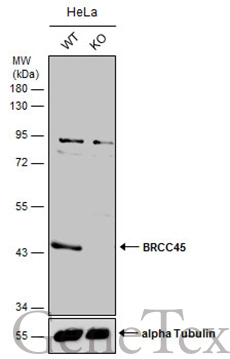
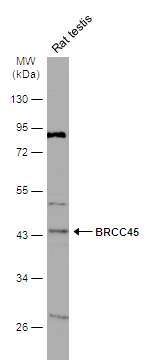
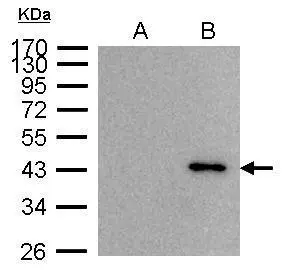
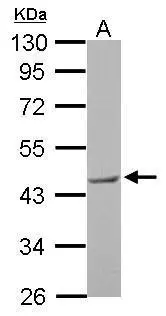
GTX105364
BRCC45 antibody

Cannot supply to this region.
- SKU:
- GTX105364
- Additional Names:
- BRISC and BRCA1 A complex member 2 , BRCC4 , BRCC45 , BRE
- Application:
- WB, IF, ICC, IP
- Concentration:
- 1 mg/ml
- Physical State:
- Liquid
- Species Reactivity:
- Human
- Purification:
- Affinity Purified
- Storage Conditions:
- -20[o]C Aliquot. Avoid freeze/thaw cycles. Store undiluted., 2-8[o]C Aliquot. Avoid freeze/thaw cycles. Store undiluted., -20[o]C/-70[o]C Aliquot. Avoid freeze/thaw cycles. Store undiluted.
- Supplier:
- Genetex
- Host:
- Rabbit
- Reactivities:
- Human, Mouse, Rat
- Buffer:
- 0.1M Tris, 0.1M Glycine, 10% Glycerol, 0.01% Thimerosal.
- Immunogen:
- Recombinant protein encompassing a sequence within the center region of human BRCC45. The exact sequence is proprietary.
- Uniprot:
- Q9NXR7
- Synonyms:
- brain and reproductive organ-expressed (TNFRSF1A modulator);brain and reproductive organ-expressed protein;BRCA1-A complex subunit BRE;BRCA1/BRCA2-containing complex subunit 45;BRCA1/BRCA2-containing complex, subunit 4;BRCC4;BRCC45;BRE;BRISC and BRCA1-A complex member 2
- Extra Details:
- Component of the BRCA1-A complex, a complex that specifically recognizes 'Lys-63'-linked ubiquitinated histones H2A and H2AX at DNA lesions sites, leading to target the BRCA1-BARD1 heterodimer to sites of DNA damage at double-strand breaks (DSBs). The BRCA1-A complex also possesses deubiquitinase activity that specifically removes 'Lys-63'-linked ubiquitin on histones H2A and H2AX. In the BRCA1-A complex, it acts as an adapter that bridges the interaction between MERIT40/NBA1 and the rest of the complex, thereby being required for the complex integrity and modulating the E3 ubiquitin ligase activity of the BRCA1-BARD1 heterodimer. Probably also plays a role as a component of the BRISC complex, a multiprotein complex that specifically cleaves 'Lys-63'-linked ubiquitin. May play a role in homeostasis or cellular differentiation in cells of neural, epithelial and germline origins. May also act as a death receptor-associated anti-apoptotic protein, which inhibits the mitochondrial apoptotic pathway. May regulate TNF-alpha signaling through its interactions with TNFRSF1A; however these effects may be indirect.
- Shipping Conditions:
- Blue Ice